


Innovative application of MOPS in novel cell fixative
Release time:
2026-03-10
In modern life science research such as high content screening, flow cytometry, and high-resolution microscopy imaging, cell fixation is a key preprocessing step to ensure sample structure stability and signal reproducibility. However, traditional aldehyde fixatives (such as formaldehyde and glutaraldehyde) can effectively crosslink proteins, but often lead to antigen epitope masking and membrane structure collapse, seriously affecting the accuracy of subsequent staining and quantitative analysis. To overcome this bottleneck, a novel cell immobilization technology based on phenoloxidase catalysis has emerged, in which MOPS buffer (3-methylpropanesulfonic acid) plays an irreplaceable role as the core buffering component.
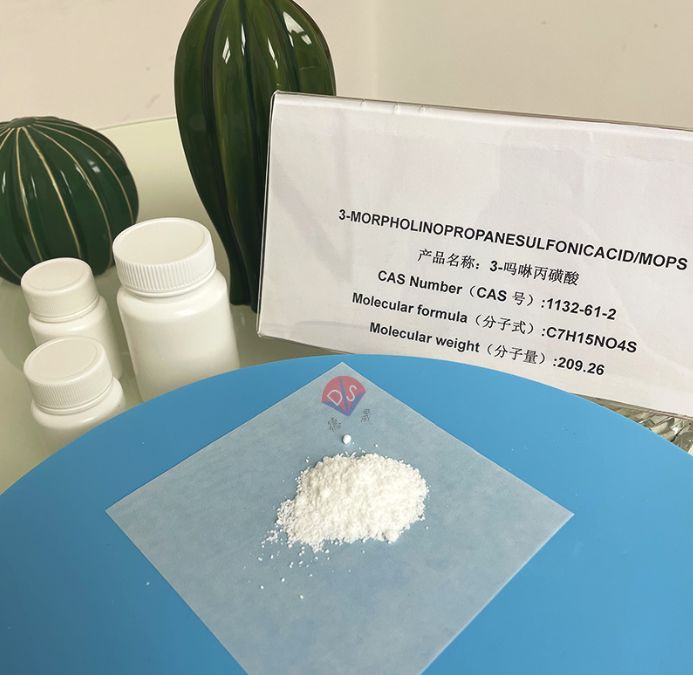
MOPS powder
Why do we need a 'phosphate free' fixed environment?
The core of this new fixation mechanism lies in the use of phenol oxidase to catalyze the oxidation of specific phenolic substrates into highly active quinone intermediates, which then undergo Michael addition or Schiff base reactions with primary amine groups on the surface of cellular proteins, forming mild and reversible covalent crosslinks. This process can maintain the overall morphology of the cell while avoiding antigen blockade caused by excessive cross-linking. However, phosphate ions (PO ₄³ ⁻) bind to the copper cofactor of phenoloxidase, significantly inhibiting its catalytic activity; Meanwhile, phosphates may cause non-specific background or quenching effects in subsequent fluorescence detection. Therefore, developing a phosphate free, pH stable, and biocompatible buffer system has become the key to the success of this fixative. In this context, MOPS stands out with its excellent physicochemical properties.
MOPS: Constructing Enzyme Activity Friendly Fixed Microenvironment
MOPS is a classic Good's buffer. In this fixative formulation, MOPS works synergistically with the ionic liquid solvent, choline dihydrogen phosphate, which provides a unique hydration microenvironment to protect the lipid bilayer structure of the cell membrane from damage; MOPS maintains the pH of the system between 6.5-7.9, ensuring a controllable rate of phenol oxidation reaction and moderate degree of crosslinking. Experiments have shown that cells fixed in MOPS buffer system have clear nuclear cytoplasmic boundaries, complete organelle morphology, and good membrane fluidity retention, which is far superior to the effect of traditional phosphate buffer fixation solution.
Avoiding fluorescence interference and improving imaging and counting accuracy
Due to the lack of absorption in the UV visible region and the absence of aromatic rings or fluorescent groups, MOPS residues do not produce background fluorescence. Meanwhile, mild covalent fixation avoids the common spontaneous fluorescence problem of aldehyde fixatives. This results in higher signal intensity and better signal-to-noise ratio for commonly used fluorescent dyes such as DAPI, FITC, and TRITC, significantly improving the reliability of automatic cell counting, confocal imaging, and multi-color labeling analysis. In addition, MOPS has stable chemical properties and is not easily oxidized or degraded. It maintains consistent performance during storage in a fixed solution, ensuring reproducibility between experimental batches - which is particularly important for high-throughput drug screening or clinical sample analysis.
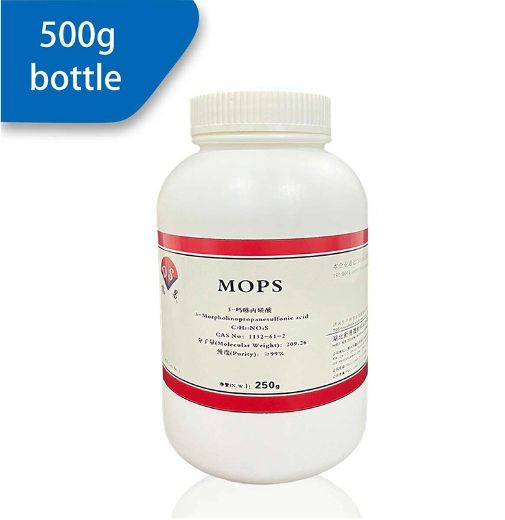
Product packaging
Hubei Xindesheng Material Technology Co., Ltd., as a professional manufacturer of biological buffering agents, has long been dedicated to the research and production of MOPS and other reagents. Its products have been widely used in fields such as cell fixation, immunohistochemistry, single-cell sequencing, and diagnostic reagent development. In the future, Xindesheng will continue to provide solid support for innovation in the fields of life sciences and healthcare with stronger delivery capabilities and better product performance.
Contact details
Contact number
Address: C8, Guanggu United Science and Technology City, Ezhou City, Hubei Province
Fax:0711-3704 589
Follow us
