


MOPS: The 'invisible guardian' of colic acid synthesis through co cultivation with Escherichia coli
Release time:
2026-03-08
In the field of biomanufacturing, viscous acid, as a high-value platform compound, has broad application prospects in the pharmaceutical, chemical, and materials industries. However, traditional single strain fermentation often faces problems such as heavy metabolic burden and accumulation of by-products, which limit its industrialization process. In recent years, a strategy based on co culture of Escherichia coli has emerged, achieving efficient conversion from glucose to mucin acid. In this biological reaction system, MOPS buffer (3- (N-morpholine) propanesulfonic acid) plays a crucial role as the core component of the fermentation medium.

MOPS powder
1、 Co cultivation strategy: modular disassembly of metabolic burden
Traditional single strain fermentation often attempts to integrate the entire mucin synthesis pathway (usually involving multiple enzymatic reactions) into a single cell. This is like having a worker responsible for both raw material procurement, production and processing, as well as quality control, which is inefficient and prone to errors. The co cultivation strategy cleverly modularizes and breaks down this complex task.
Researchers have constructed two genetically engineered strains of Escherichia coli with complementary functions. One strain (Module A) is specifically responsible for converting glucose into intermediate products (such as catechol), while another strain (Module B) is specifically responsible for efficiently converting intermediate products into viscous acids. This mode of division of labor and collaboration not only reduces the metabolic burden of individual strains, but also avoids the toxicity or feedback inhibition caused by the accumulation of intermediate products within a single strain, thereby significantly improving the overall conversion efficiency.
2、 MOPS: The 'sea calming needle' that maintains the cellular microenvironment
In a co culture system, the harmonious coexistence of two strains is the key to success. They need to grow, metabolize, and 'feed' each other in the same fermentation tank. This places high demands on the fermentation environment, especially the stability of pH value. MOPS, as an excellent biological buffering agent, plays an irreplaceable role at this moment.
Accurate pH regulation: The effective buffering range of MOPS is usually between pH 6.5-7.9, which precisely covers the suitable growth and metabolic range of Escherichia coli. During the fermentation process, bacterial metabolism produces acidic or alkaline substances, leading to drastic fluctuations in the pH of the culture medium. MOPS can quickly neutralize these substances, stabilize the pH within a predetermined narrow range, and provide a stable "working environment" for both strains.
Low metal ion chelating ability: Unlike phosphate buffer solution, MOPS has extremely low chelating ability for metal ions. This means that the essential metal ions in the culture medium (such as Mg ² ⁺, Ca ² ⁺, etc.) can be freely utilized by the bacterial cells without being "locked" by buffering agents, ensuring the normal growth of bacterial cells and enzyme activity.
High osmotic pressure tolerance: MOPS itself has low permeability to cell membranes and does not cause osmotic pressure stress to bacterial cells. In culture media containing inorganic salts such as NaCl, the presence of MOPS helps maintain the balance of intracellular and extracellular osmotic pressure, protecting the integrity of cell structure.
3、 Synergistic effect: MOPS assists in efficient conversion
In an inorganic salt culture medium composed of MOPS, glucose, Na ₂ HPO ₄, NaCl, etc., the two engineered strains exhibited astonishing synergistic effects. Module A strain grows rapidly in a stable MOPS buffer environment, efficiently converting glucose into intermediate products; Module B strain utilizes these intermediate products to efficiently express key enzymes at a stable pH maintained by MOPS, converting the intermediate products into viscous acid.
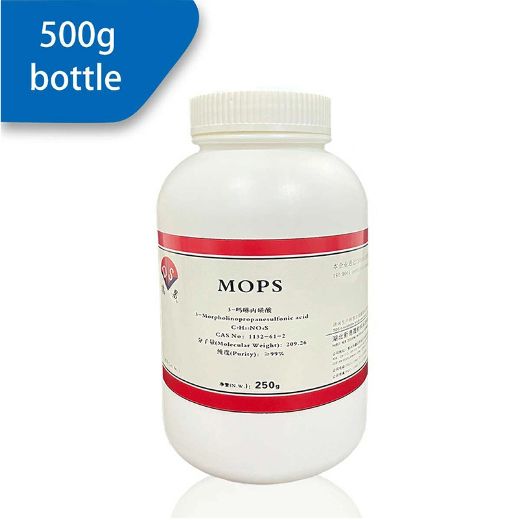
Product packaging
4、 Conclusion and Prospect: New Desheng Helps with Biological Manufacturing
With the development of synthetic biology and metabolic engineering, the demand for high-quality biological buffering agents such as MOPS will continue to grow. Hubei Xinde Shengcai, with its profound accumulation in the research and production of biological buffering agents, has provided high-purity and highly stable MOPS products for the scientific and industrial communities. New Desheng's MOPS products have small batch differences and low impurity content, ensuring the reproducibility of experimental data and the stability of fermentation processes. Welcome to inquire and order!
Previous page
Previous page
Contact details
Contact number
Address: C8, Guanggu United Science and Technology City, Ezhou City, Hubei Province
Fax:0711-3704 589
Follow us
