


The key role of HEPES in the preparation of porous sponge like hydrogel
Release time:
2026-03-05
In recent years, hyaluronic acid (HA) based hydrogels have shown great potential in wound repair, medical and aesthetic filling and other fields due to their excellent biocompatibility, high water retention capacity and controllable three-dimensional porous structure. Among them, the super absorbent hyaluronic acid porous sponge like hydrogel has become a hot material in regenerative medicine research because of its physical properties similar to extracellular matrix. However, in its preparation process, a crucial step - "acid removal treatment" - directly determines the purity, pore stability, and biosafety of the final product. Among various optional buffer systems, HEPES buffer is becoming an ideal acid removal medium in this process due to its mild, stable, and physiologically compatible characteristics.
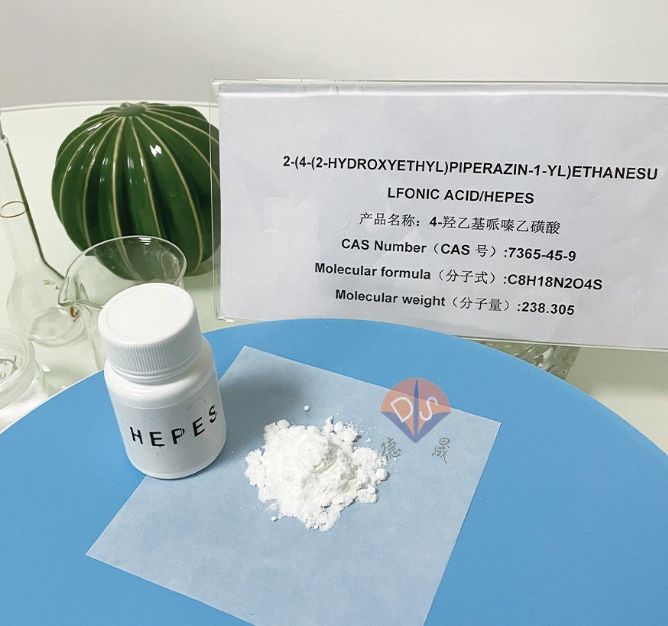
HEPES powder
Why is "removing acid" the key link of hydrogel molding?
In the synthesis of hyaluronic acid porous hydrogels, pores are usually induced by chemical crosslinking (such as the use of carbodiimide reagents) or freeze drying. This process is often accompanied by the formation of acid by-products (such as hydrochloric acid and organic acid). If they are left in the gel network, they will not only reduce the pH of the material, but also may cause the following problems: first, the main chain structure of hyaluronic acid is destroyed, leading to the decline of molecular weight and deterioration of mechanical properties; Secondly, it affects the adhesion and proliferation of subsequent cell inoculation; The third is to cause local inflammatory reactions after implantation. Therefore, residual acidic substances must be thoroughly removed through the "acid removal" step.
The conventional method is to soak the nascent hydrogel in a weak alkaline buffer solution, and gradually neutralize and elute the acidic components through ion exchange and diffusion. This process needs to last for 12 to 48 hours, and fresh buffer should be replaced every 1-3 hours to maintain a stable pH gradient and cleaning efficiency. At this point, the selection of buffer solution is particularly crucial.
HEPES: Providing a gentle microenvironment for acid removal
Among numerous buffer solutions, HEPES (4-hydroxyethylpiperazine ethanesulfonic acid) exhibits unique advantages. Its effective buffering range is pH 6.8-8.2, which precisely covers the physiological neutral range. In the process of acid removal, HEPES can effectively neutralize weakly acidic residues without causing hydrolysis of hyaluronic acid glycosidic bonds or collapse of cross-linked networks due to strong alkalinity - which is difficult to control in phosphate or Tris systems, especially when the local pH suddenly increases.
More importantly, HEPES is a non-ionic Good's buffer that hardly chelates with metal ions and does not undergo non-specific interactions with hyaluronic acid molecules. This ensures that the porous structure of the hydrogel remains intact during long-term immersion, avoiding pore shrinkage or surface collapse, thus maintaining its high water absorption.

Product packaging
Hubei Xindesheng HEPES Professional Manufacturer
In the precise preparation of superabsorbent hyaluronic acid porous sponge like hydrogel, HEPES does not constitute the main body of the material, but protects its structural integrity and biological functionality in a way of "moistening the material silently". Choosing high-purity and stable HEPES buffer solution is not only a reflection of process optimization, but also a solemn commitment to the safety of terminal applications. Hubei Xindesheng Material Technology Co., Ltd. is committed to providing customers with reliable HEPES and other biological buffering agents. If you need them, please feel free to contact us!
Contact details
Contact number
Address: C8, Guanggu United Science and Technology City, Ezhou City, Hubei Province
Fax:0711-3704 589
Follow us
