


HEPES and MOPS: Key Buffer Solutions in Charge Directed Enzyme Fixation Technology
Release time:
2026-03-04
In cutting-edge fields such as biocatalysis, in vitro diagnostics, and biosensors, efficient immobilization of enzymes is a core step in improving their stability, reusability, and reaction efficiency. In recent years, the "enzyme immobilization method based on charge oriented crosslinking" has received widespread attention due to its ability to achieve ordered arrangement of enzyme molecules on the carrier surface and optimize the orientation of active sites. This technology highly relies on the precise regulation of the pH of the reaction system - acidic conditions are usually used to activate the surface groups of the carrier, while alkaline environments are more conducive to the directed exposure and covalent crosslinking of enzyme molecule surface charges. During this process, HEPES buffer and MOPS buffer have become key buffer solutions for constructing stable alkaline microenvironments due to their excellent buffering performance and biocompatibility.
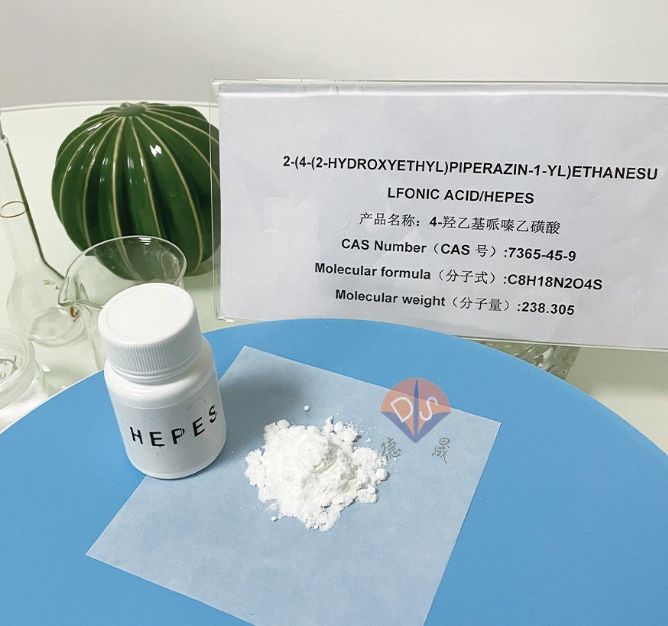
HEPES powder
Charge oriented fixation: pH is a key variable determining success or failure
The basic principle of charge directed crosslinking method is to utilize the distribution characteristics of the net charge carried by enzyme proteins at a specific pH, so that they are pre adsorbed on the surface of functionalized carriers through electrostatic interactions, and then covalently anchored by chemical crosslinking agents (such as glutaraldehyde). This process is highly sensitive to pH: if the pH deviates too far from the isoelectric point (pI) of the enzyme, it may lead to non-specific adsorption or conformational inactivation; If the buffering capacity is insufficient, local reactions can release heat or the addition of reagents can easily cause pH fluctuations, disrupting directional alignment.
Research has shown that in the alkaline range (pH 7.0-8.5), most key industrial enzymes such as oxidoreductases and hydrolases exhibit stable negative charge distributions on their surfaces, which facilitate directional binding with cationic carriers. At this time, traditional carbonate or phosphate buffer systems are difficult to handle due to insufficient buffer capacity or interference with metal ions. HEPES (4-hydroxyethylpiperazine ethanesulfonic acid) and MOPS (3-methylpropanesulfonic acid), as members of the Good's buffer family, precisely cover this critical pH window.
HEPES and MOPS: Alkaline buffered Gemini Stars with Each Advantage
The effective buffering range of HEPES is pH 6.8-8.2, with high water solubility, low cytotoxicity, and extremely weak metal chelating ability, making it particularly suitable for the immobilization process of enzymes containing metal cofactors such as peroxidases and dehydrogenases. The hydroxyethyl and piperazine rings in its molecular structure endow it with good chemical stability, making it difficult to degrade during long-term reactions or freeze-drying redissolution processes, ensuring consistency of the immobilized batch.
The effective buffering range of MOPS is pH 6.5-7.9, slightly neutral, but its sulfonic acid groups provide stronger ionic strength stability and perform better in high salt or complex matrix environments. In addition, MOPS has extremely low absorption in the ultraviolet region and does not interfere with enzyme activity evaluation based on spectral detection, making it more advantageous in processes that require real-time monitoring of immobilization efficiency. In practical applications, researchers can flexibly choose HEPES buffer or MOPS buffer based on the isoelectric point, carrier properties, and subsequent application scenarios of the target enzyme to achieve better directional fixation effects.

Product packaging
Hubei Xindesheng Material Technology Co., Ltd. has been deeply involved in the field of biological buffering agents for many years. We can provide high-purity HEPES and MOPS products (purity ≥ 99.5%), strictly control the content of heavy metals (≤ 10 ppm), ammonium salts, and organic impurities, and have passed ISO quality management system certification. The company's products have been widely used in fields such as enzyme immobilization, diagnostic reagent development, cell culture, and protein purification, and can provide customized solutions and technical support according to customer needs.
Previous page
Previous page
Contact details
Contact number
Address: C8, Guanggu United Science and Technology City, Ezhou City, Hubei Province
Fax:0711-3704 589
Follow us
