


Luminol dances with cholesterol oxidase, illuminating a new era of high-throughput electrochemiluminescence imaging
Release time:
2025-12-20
Today, as cell biology research continues to deepen, non-destructive, real-time, and high-throughput functional analysis of individual cells has become a coveted goal for researchers. However, although traditional electrochemical techniques have advantages such as label free and high sensitivity, they are limited by low flux bottlenecks and difficult to meet clinical translation needs. In this context, a research team from a certain university has successfully developed an innovative electrochemiluminescence (ECL) imaging system that cleverly integrates two key molecules, luminol and cholesterol oxidase, to overcome the technical challenge of high-throughput electrochemical analysis of single adherent cells and open up a new path for single-cell functional imaging.
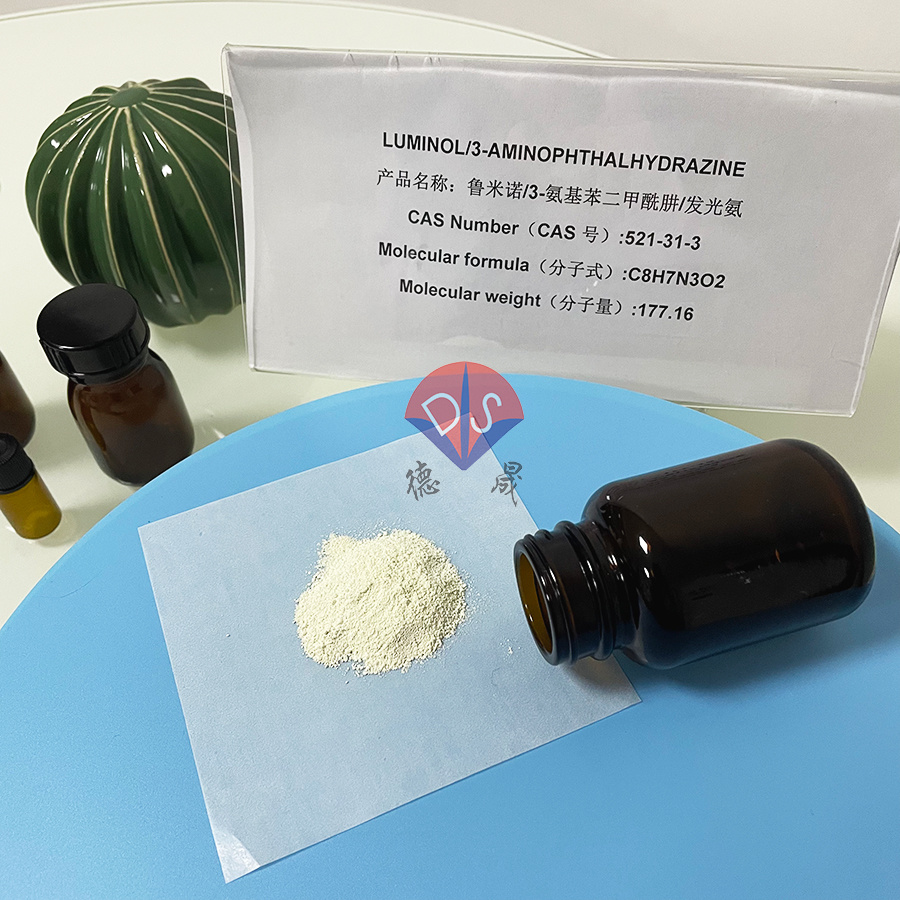
luminol powder
Luminol: the "messenger of light" that illuminates cell surface reactions
The breakthrough of this system lies in abandoning the traditional detection mode that relies on micro machined electrode arrays, and instead using luminol in the solution phase as the ECL probe. Researchers directly added luminol to the cell culture system. After applying an appropriate voltage, luminol can undergo efficient electrochemiluminescence reaction with hydrogen peroxide (H ₂ O ₂) naturally released or enzymatically generated on the cell surface, producing a strong photon signal.
The advantage of this strategy lies in the unity of "label free" and "high-throughput": it can reflect the metabolic activity of cells in real time without the need for genetic modification or fluorescence staining; Meanwhile, with the help of a high-sensitivity single photon camera, the system can capture luminescence images of hundreds or even thousands of cells at once, achieving parallel analysis. Luminol not only serves as a chemiluminescence substrate, but also as a "converter" that converts micro electrochemical events into macro optical signals, simplifying experimental setup and improving detection efficiency and reproducibility.
Cholesterol oxidase: the "molecular key" targeting lipid metabolism
To further expand the functional boundaries of the platform, the research team introduced cholesterol oxidase, which specifically recognizes cholesterol molecules on the cell membrane surface and catalyzes their oxidation to generate H ₂ O ₂. The newly generated hydrogen peroxide immediately triggers the ECL reaction of luminol, forming a light signal intensity positively correlated with cholesterol content.
Through this design, the system has achieved high-throughput imaging analysis of membrane cholesterol distribution at the single-cell scale. This not only provides an intuitive tool for studying biological processes such as cell membrane fluidity, receptor aggregation, and pathogen invasion mechanism, but also opens a new path for early screening of atherosclerosis, neurodegenerative diseases, cancer and other diseases related to abnormal lipid metabolism. The catalytic ability of cholesterol oxidase endows the entire imaging system with molecular specificity, enabling it to leap from a universal electrochemical sensing to a functionally oriented targeted analysis platform.
Simplifying devices and improving efficiency: a crucial step towards clinical translation
Compared to traditional single-cell electrochemical detection methods that rely on micro nano machining electrode arrays, this new ECL imaging system does not require complex chip manufacturing processes and only requires conventional electrochemical cells and optical imaging equipment to operate, significantly reducing technical barriers and costs. This imaging technology avoids complex electrode processing procedures, simplifies experimental equipment, greatly improves detection efficiency and application scope, and provides a new research platform for rapid single-cell analysis and drug screening.
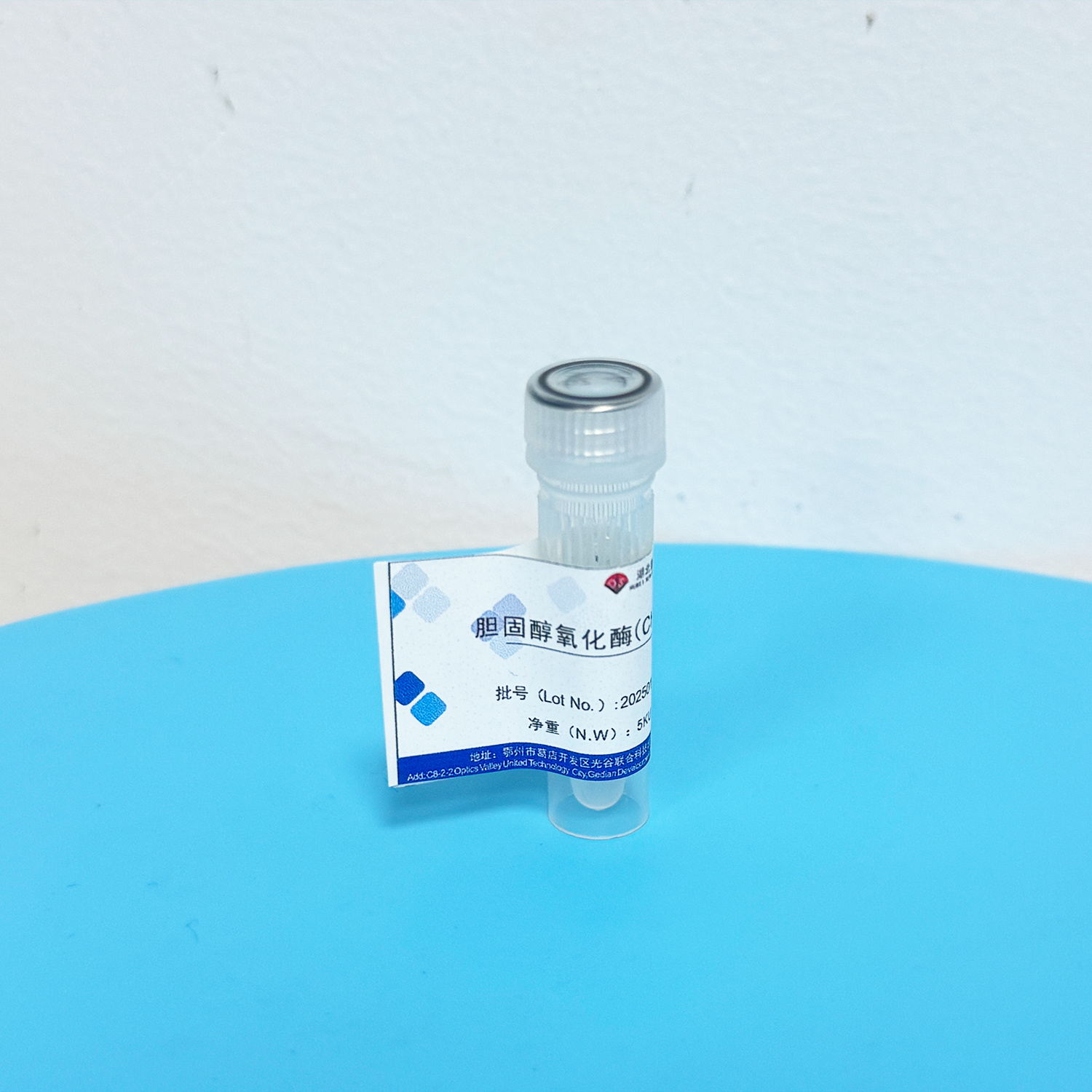
cholesterol oxidase
High quality core reagents are the key cornerstone of technology implementation in cutting-edge fields such as electrochemiluminescence, single-cell analysis, and biosensing. As a professional diagnostic reagent supplier in China, Hubei Xindesheng has long focused on the research and production of luminol series compounds, cholesterol oxidase, peroxidase, and other key components of ECL. The company's products have high purity, stable activity, and excellent batch consistency, and have successfully served numerous universities, research institutions, and in vitro diagnostic enterprises, receiving unanimous praise from numerous customers.
Contact details
Contact number
Address: C8, Guanggu United Science and Technology City, Ezhou City, Hubei Province
Fax:0711-3704 589
Follow us
