


Key applications and advantages of HEPES in cell cryopreservation
Release time:
2024-06-07
In the process of cell culture, cryopreservation is a crucial step to ensure long-term storage of cells for subsequent research. Due to the potential instability and even necrosis of cells caused by the freezing process, scientists need to develop specific freezing solution formulations for different cell lines to optimize the preservation effect. Therefore, cryopreservation technology has important value in cell preservation. The application of HEPES buffer in cryopreservation is mainly reflected in the following aspects.
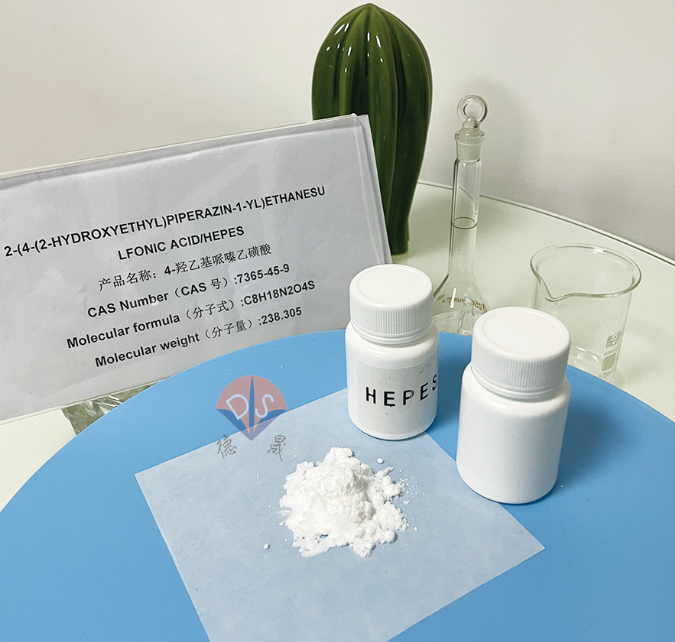
HEPES powder
Buffering performance: HEPES is a weak acid with a pKa (negative logarithmic acid ion departure constant) of approximately 7.55, suitable for providing buffering within the physiological pH range. During the process of cell cryopreservation, low temperature may cause changes in the pH value of the intracellular and extracellular environments. HEPES can stabilize the pH environment, which helps with cell survival and recovery.
Stability: During the freeze-thaw process, the culture medium may encounter issues such as crystallization, solute precipitation, polarity changes, pH changes, and concentration changes. By mixing Na-P (20-100 mM) with 50 mM HEPES solution, stable acidity changes can be observed within the expected concentration range, which helps maintain cell stability during the freezing process.
Antibacterial properties: HEPES has antibacterial properties that can inhibit the growth of bacteria and other microorganisms, reducing the risk of sample contamination. This is particularly important during cell cryopreservation, as contamination may lead to cell death or affect the recovery effect of cells.
Provide ion environment: HEPES is an ion buffer that can provide an ion environment, regulate the charge properties of proteins, and help with protein separation and purification.
When using HEPES for cell cryopreservation, it is necessary to choose the appropriate concentration and pH value based on specific experimental conditions and requirements. At the same time, it is necessary to combine other cryoprotectants (such as DMSO, glycerol, ethylene glycol, etc.) to improve the cryopreservation effect. HEPES has several obvious advantages in cryopreservation, which are mainly reflected in the following aspects.
Reducing ice crystal formation: During the freezing process, the crystallization of water molecules may cause drastic changes in the intracellular and extracellular environments, which may cause mechanical damage to cells. The addition of HEPES can reduce the formation of ice crystals through its intermolecular interactions, thereby protecting cells from these potential damages.
Antibacterial and anti-corrosion properties: HEPES has antibacterial and anti-corrosion capabilities, which can reduce the risk of microbial contamination of samples during cryopreservation. This is particularly important for maintaining long-term storage of samples and maintaining cell viability.
Wide application range: HEPES is not only suitable for cryopreservation of mammalian cells, but also widely used in other types of cells and tissues, such as bacteria, yeast, insect cells, and plant tissues. This indicates that HEPES has broad applicability and universality.

Product packaging
In summary, the advantages of HEPES in cryopreservation mainly lie in its ability to maintain pH stability, reduce ice crystal formation, possess antibacterial and preservative properties, low toxicity, and cell recovery effects. The HEPES produced by Desheng is an ideal cryopreservation additive widely used in fields such as cell biology, biomedicine, and biotechnology.
Contact details
Contact number
Address: C8, Guanggu United Science and Technology City, Ezhou City, Hubei Province
Fax:0711-3704 589
Follow us
