


HEPES for lactate dehydrogenase detection kit: pH stability support for reaction system
Release time:
2026-01-06
In vitro diagnosis, lactate dehydrogenase (LDH) is one of the commonly used biochemical indicators in clinical practice, which can be used to assist in evaluating myocardial injury, liver dysfunction, hemolytic diseases, and other conditions. The stability of its detection results is closely related to the design of the reagent system. In the detection process, in addition to enzymes and coenzymes, the role of the buffer system is equally important. HEPES buffer(4-hydroxyethylpiperazine ethanesulfonic acid), as a commonly used buffer, has been applied in some lactate dehydrogenase detection kits to maintain pH stability in the reaction environment.
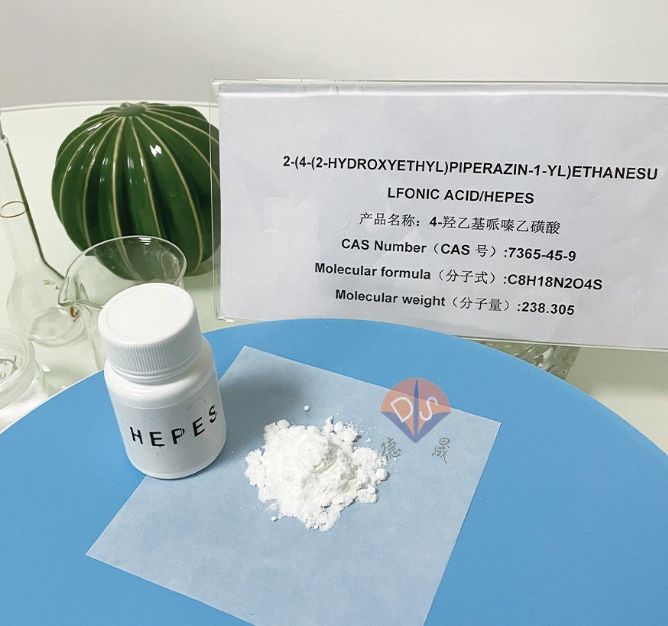
HEPES powder
The basic principle of lactate dehydrogenase detection
The activity detection of lactate dehydrogenase is usually carried out using kinetic methods. In the reaction system, LDH catalyzes the conversion of L-lactic acid to pyruvic acid, while reducing NAD ⁺ to NADH. NADH has an absorption peak at a wavelength of 340 nm, and the activity of LDH can be calculated by detecting the rate of increase in absorbance at this wavelength.
This reaction is sensitive to pH. Research has shown that the optimal pH range for LDH is between 6.5-8. If the pH of the reaction system deviates from this range, it may affect the conformation of the enzyme and lead to a decrease in catalytic efficiency. In addition, hydrogen ions may be generated during the reaction process. Without effective buffering, the pH of the system will gradually decrease, affecting the linearity of the reaction.
The role of HEPES in reaction systems
Common buffering agents include phosphate, Tris, and HEPES. Phosphates may form precipitates with metal ions under certain conditions, which can affect the detection results; Tris has a pKa of approximately 8.1, limited buffering capacity within the physiological pH range, and is sensitive to temperature changes. The pH range required for the reaction between HEPES and LDH matches well. It has strong buffering ability in the pH range of 6.8-8.2, which can reduce pH fluctuations caused by reaction or external interference. In addition, HEPES does not form complexes with metal ions, has low absorption of ultraviolet light, and has no significant inhibitory effect on enzyme activity.
The Effect of HEPES on Reagent Performance
The use of HEPES in LDH detection reagents helps maintain the pH stability of the reaction system, thereby ensuring the reproducibility of the reaction rate. A stable buffering environment also helps to improve performance consistency between different batches of reagents. Due to its stable chemical properties, HEPES is not easily decomposed under storage conditions of 2-8 ℃. For different types of samples, such as serum, plasma, etc., HEPES can also maintain the pH of the system within a certain range, reducing the impact of sample matrix.
HEPES products from Hubei Xindesheng
Hubei Xindesheng Material Technology Co., Ltd. produces buffering agents such as HEPES, Tris, MOPS, etc., which are used in fields such as in vitro diagnostics and scientific research. The company uses synthesis and purification processes to prepare HEPES, with a product purity of ≥ 99%, and conducts tests on moisture, heavy metals, pH buffering performance, and other factors. The product provides technical documentation and supports different packaging specifications.

Product packaging
Hubei Xindesheng Material Technology Co., Ltd. is deeply engaged in the field of biological buffering agents, focusing on the research and production of HEPES, Tris, MOPS and other biological buffering agents. The company adopts advanced synthesis and purification processes to ensure that HEPES products have a purity of ≥ 99%, low residual heavy metals, strict moisture control, and fully comply with the raw material standards for in vitro diagnostic reagents. Each batch undergoes pH buffering performance testing, absorbance detection, and batch consistency verification, supporting customized packaging and technical documentation.
Previous page
Previous page
Contact details
Contact number
Address: C8, Guanggu United Science and Technology City, Ezhou City, Hubei Province
Fax:0711-3704 589
Follow us
