


HEPES buffer: how to safeguard in vitro fertilization (IVF) technology
Release time:
2025-05-21
Since the birth of in vitro fertilization (IVF) technology in the 1950s, it has demonstrated extraordinary potential in fields such as animal reproduction, medical research, and endangered animal conservation. With rapid development in the past 20 years, IVF technology has moved from the laboratory to clinical practice, becoming a mature and routine biotechnology. During this process, a substance called HEPES buffer (4-hydroxyethylpiperazine ethanesulfonic acid) silently guards every critical step of in vitro fertilization with its excellent buffering ability.
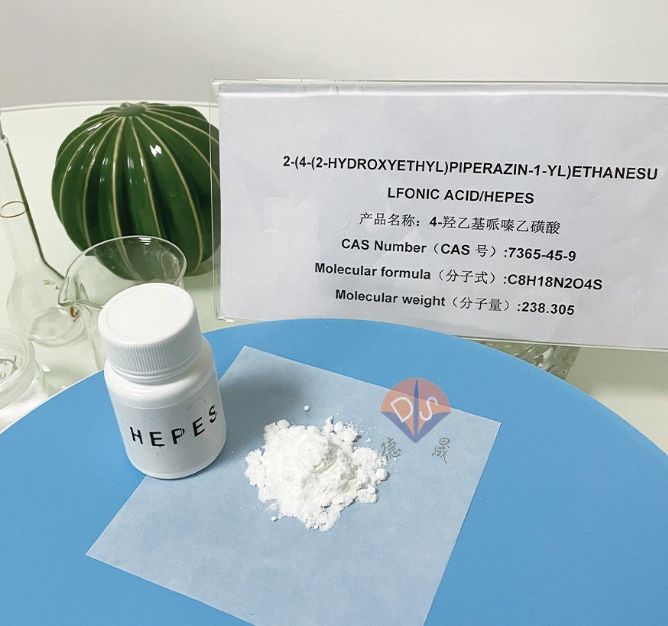
HEPES powder
HEPES: The 'pH Stabilizer' in In Vitro Fertilization
In IVF operations, the stability of the culture environment directly affects the success or failure of the experiment. The traditional bicarbonate dependent buffer system is highly dependent on a 5% CO ₂ environment. Once removed from the incubator (such as open procedures such as microscopy and embryo grading), rapid loss of CO ₂ can cause the pH of the culture medium to rise sharply from 7.4 to above 8.0 within minutes. This drastic fluctuation can directly damage sperm vitality, interfere with oocyte maturation, and even lead to embryonic development arrest.
The unique advantage of HEPES lies in its buffering mechanism designed specifically for open environments:
1. CO ₂ independence: can maintain an ideal pH range of 7.0-7.4 in an open operating environment.
2. Temperature stability: The buffering efficiency can be maintained from the 37 ℃ incubator to room temperature operation.
3. Low cytotoxicity: A concentration of 20-25mM can provide sufficient protection without affecting oocyte maturation and sperm motility.
Key application scenarios of HEPES in IVF
1. Sperm screening
In the sperm pretreatment stage, specialized buffer solutions containing HEPES (such as HEPES-HTF medium) play multiple roles:
Efficient washing and purification: Remove harmful components such as antioxidant enzyme inhibitors from semen, while avoiding damage to sperm membrane potential by stabilizing pH.
2. In vitro maturation of oocytes
Taking bovine oocyte culture as an example, 25mM HEPES must be added to TCM-199 basic medium to prevent
Frequent observation of pH fluctuations affects the process of meiosis. Studies have shown that the maturation rate of oocytes in the HEPES group is significantly better than that in the simple bicarbonate buffer system.
3. Fertilization and early embryo culture
In the stage of sperm egg fusion and early embryo culture:
Efficiency improvement: HEPES buffered co culture medium prolongs the in vitro operation time window, increasing the success rate of sperm egg binding by 20%.
Operation protection: Protect embryos from pH shock during open procedures such as embryo grading and micro manipulation.

Product packaging
HEPES, as an indispensable substance in the culture medium, has important value in fully utilizing excellent variety resources, shortening the breeding cycle of livestock, and accelerating the speed of variety improvement. As a professional manufacturer in the field of biological buffering agents, Desheng New Materials is well aware of the key role of HEPES in assisted reproductive technology. We are willing to work with you to promote the innovation of animal husbandry breeding technology and create more miracles of life with professional products and services.
Contact details
Contact number
Address: C8, Guanggu United Science and Technology City, Ezhou City, Hubei Province
Fax:0711-3704 589
Follow us
