


Desheng shares with you the application direction of HEPES market
Release time:
2024-10-20
HEPES (4-hydroxyethylpiperazine ethanesulfonic acid) is a widely used biological buffering agent in the fields of biochemistry and molecular biology. Its molecular formula is C8H18N2O6S and its molecular weight is 238.3. HEPES is favored for its excellent buffering performance and stability over a wide pH range, especially for cell culture and biomedical research. Below, Desheng Technology will share with you the market application direction of HEPES buffer.
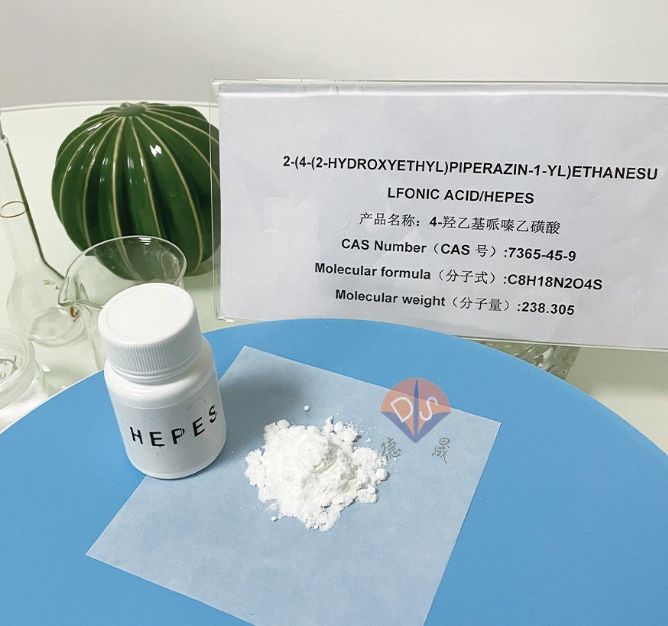
HEPES buffer powder
HEPES (4-hydroxyethylpiperazine ethanesulfonic acid) is a widely used biological buffering agent in the fields of biochemistry and molecular biology. Its molecular formula is C8H18N2O6S and its molecular weight is 238.3. HEPES is favored for its excellent buffering performance and stability over a wide pH range, especially for cell culture and biomedical research. Below, Desheng Technology will share with you the market application direction of HEPES.
Molecular Biology Research
In DNA and RNA extraction, PCR reaction, gel electrophoresis and Southern and Northern blotting, HEPES is used as a buffer component to help maintain the pH stability of the reaction environment. It is also used in enzyme activity assays and DNA research, providing a suitable working environment for enzymes.
cell culture
HEPES is often added to serum-free culture media to help maintain the pH value of the culture medium, especially in situations where CO2 levels are unstable, such as prolonged transportation or CO2 control imbalance in the incubator. It is crucial for maintaining the physiological state and function of cells, especially in long-term cultivation or experiments that require accurate pH control.
Protein Purification and Structural Studies
HEPES buffer can be used for protein dissolution, precipitation, chromatography, and crystallization processes, helping to maintain the structural and functional integrity of proteins. In X-ray crystallography and nuclear magnetic resonance (NMR) spectroscopy, HEPES can be used as a buffer to stabilize protein conformation and facilitate structural analysis.
Pharmacology and drug development
HEPES buffer can be used for in vitro pharmacological and pharmacokinetic studies, simulating the human internal environment, and evaluating the stability and biological activity of drugs. HEPES helps maintain consistency in experimental conditions and reduce errors caused by pH fluctuations in drug screening and toxicity testing.
Biochemical analysis
HEPES buffer is widely used in biochemical analysis, such as enzyme activity determination, metabolite detection, cell signal transduction research, etc., to ensure the stability and reproducibility of reaction conditions. However, it should be noted that although HEPES is superior to other buffering agents in many aspects, it may have an impact on certain sensitive biochemical reactions or cell types, so the selection of buffering agents should be considered based on specific applications.
In summary, HEPES is a widely used biological buffering agent in biochemistry and molecular biology, with applications in molecular biology research, cell culture, protein purification and structural studies, pharmacology and drug development, and biochemical analysis. However, when selecting buffering agents for specific sensitive biochemical reactions or cell types, the applicability of HEPES should be carefully considered.
DeSheng is a high-tech enterprise specializing in the research and production of biological buffering agents. Since its establishment in 2005, it has accumulated rich production experience and research and development strength. The HEPES (4-hydroxyethylpiperazine ethanesulfonic acid) produced by the company is known for its high purity, stability, and wide application, and has become a trusted choice for domestic and foreign customers.
Contact details
Contact number
Address: C8, Guanggu United Science and Technology City, Ezhou City, Hubei Province
Fax:0711-3704 589
Follow us
