


Does MES buffer have buffering capacity at pH 5.5
Release time:
2024-09-17
In fields such as biochemistry and molecular biology, buffering agents can maintain the stability of solutions within a specific pH range, protecting biomolecules (such as proteins and DNA) from damage caused by acid-base changes. MES buffer (2-morpholinoethanesulfonic acid), as a commonly used good buffering agent, is widely used in biological experiments due to its excellent buffering performance and biocompatibility in aqueous solutions. Below, Desheng will mainly talk about whether MES buffer has buffering ability at pH 5.5.
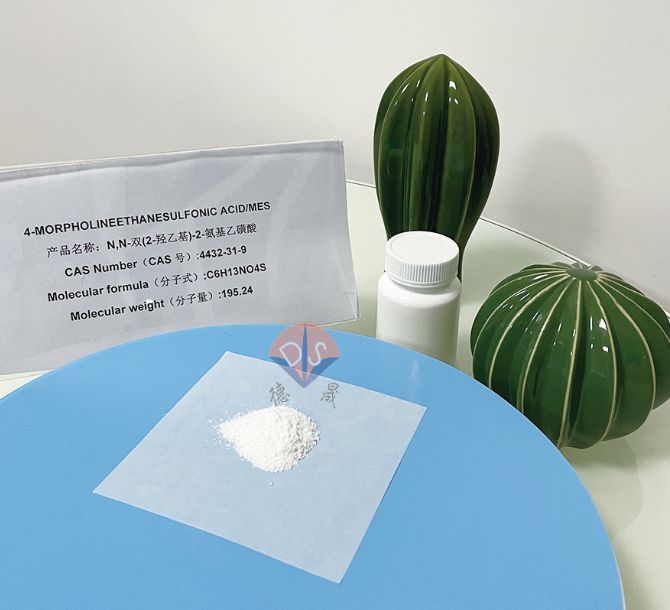
MES buffer
Chemical properties of MES buffer
MES, It is a zwitterionic compound with a molecular structure that contains both acidic groups (sulfonic acid groups) and basic groups (nitrogen atoms in the morpholine ring). This structural characteristic allows MES buffer to accept or release protons within a specific pH range, thereby exerting a buffering effect. The buffering effect of buffering agents is based on the reversibility of acid-base neutralization reactions. When there is a small amount of strong acid or strong base in the solution, the acidic groups (sulfonic acid groups) in MES molecules can react with hydroxide ions (OH ⁻), releasing protons (H ⁺) and lowering the pH of the solution; On the contrary, alkaline groups (nitrogen atoms in the morpholine ring) can accept protons, increasing the pH of the solution. This dynamic equilibrium process slows down the rapid changes in solution pH.
The buffering capacity of MES buffer at pH 5.5
1. PH value and buffer range of MES
The buffering capacity of buffering agents is closely related to their pH value. The pH value of MES is usually between 5.5-6.7 (depending on experimental conditions), which means that MES has strong buffering ability in the vicinity of this pH range.
2. Buffer performance at pH 5.5
Although the pH value of MES is between 5.5-6.7, MES still has buffering capacity at pH 5.5. This is because MES molecules exist partially in acidic form (undissolved state) under this pH condition, which can respond to changes in acidity and alkalinity in the system. Specifically, when a small amount of strong acid is present in the system, the undissolved portion of MES can accept protons, slowing down further pH decline; Similarly, when a small amount of strong alkali is present in the system, the dissociation part of MES can release protons to counteract the increase in pH. Although this buffering effect may not be as significant within the pH range, it is still sufficient to maintain the relative stability of solution pH in many experiments and applications.
3. Influencing factors
(1) Concentration: The higher the concentration of MES buffer, the greater the buffering capacity it provides, which means it can maintain a more stable pH under the same acid-base interference.
(2) Temperature: Changes in temperature can affect the dissociation equilibrium of MES, thereby affecting its buffering capacity. Generally speaking, as the temperature increases, the dissociation degree of MES increases, and the buffering range may shift slightly, but overall it can still provide ideal buffering around pH 5.5.
(3) Ionic strength: Other ions in the solution can affect the dissociation behavior of MES molecules, thereby altering their buffering properties. High ion strength may reduce the buffering capacity of MES.
Application of MES buffer at pH 5.5
1. Cell culture
MES buffer is widely used in buffer culture media for yeast and mammalian cells due to its good biocompatibility and buffering ability within a suitable pH range. These cell types can only maintain ideal growth and metabolic status under specific pH conditions, and the addition of MES helps maintain this balance.
2. Lower ion mobility and conductivity
In chromatography and electrophoresis experiments, MES showed lower ion mobility and conductivity, which is one of its important advantages as a buffer solution. A lower ion mobility helps reduce ion interference and peak tailing phenomena during the experimental process, improving separation efficiency and resolution. Meanwhile, lower conductivity also helps to reduce energy consumption and instrument losses.
3. Suitable for multiple separation modes
MES buffer is suitable for a variety of chromatographic and electrophoretic separation modes, including ion exchange chromatography, gel filtration chromatography, isoelectric focusing electrophoresis, etc. Its wide applicability makes MES one of the indispensable buffering agents in the laboratory.
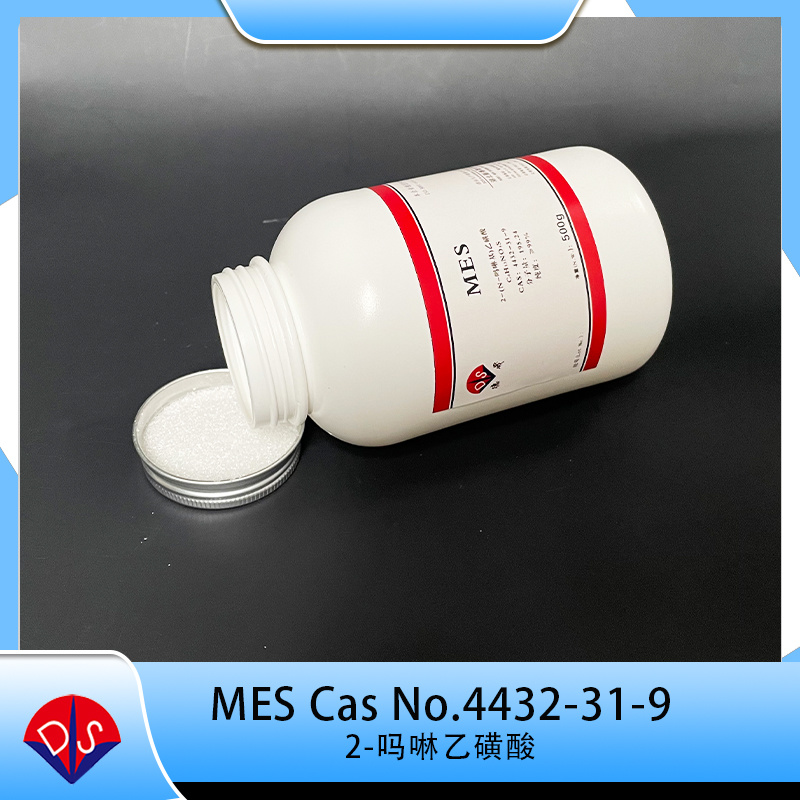
Product packaging
MES buffer still has buffering capacity at pH 5.5, but it is also affected by various factors such as concentration, temperature, and ion strength. Through reasonable experimental design and optimized operating conditions, its buffering advantage in acidic environments can be fully utilized. As a supplier of biological buffer raw materials such as MES, Desheng can provide products with low prices, small batch differences, and complete specifications to meet various needs. Welcome interested parties to click on the website for consultation or on-site inspection!
Contact details
Contact number
Address: C8, Guanggu United Science and Technology City, Ezhou City, Hubei Province
Fax:0711-3704 589
Follow us
