


The main manifestations of the effect of pH changes in MOPS buffer on electrophoresis
Release time:
2024-07-25
The role of MOPS buffer cannot be ignored in electrophoresis experiments. It is a biological buffer belonging to Good's buffer. It has good solubility in water and good chemical stability. Not only can it maintain a constant pH value of the solution, but it can also enhance the conductivity of the solution, which is beneficial for molecular migration. The following will focus on the main impact of pH changes in MOPS buffer on electrophoresis experiments.
Application of MOPS in electrophoresis
MOPS buffer is commonly used in electrophoresis experiments to maintain the pH stability of the system. Its applications include isoelectric focusing (IEF) in two-dimensional gel electrophoresis and RNA separation and membrane transfer in Northern hybridization.

MOPS buffer
The mechanism of MOPS buffer in electrophoresis
During electrophoresis, the positive and negative electrodes in the solution undergo electrolytic reactions. The oxidation reaction at the positive electrode can cause the solution to become acidic, while the reduction reaction at the negative electrode can cause the solution to become alkaline. With the extension of electrophoresis time, these changes will significantly affect the pH value of the solution, thereby affecting the experimental results. MOPS buffer can neutralize the acid or base generated by electrode reactions through its acid-base interaction, thereby maintaining the pH value of the solution basically unchanged. This balancing effect is important for the stability of electrophoresis experiments.
The specific manifestation of the effect of pH change in MOPS buffer on electrophoresis
1. Changes in migration rate
In electrophoresis, the migration rate of sample molecules is closely related to the pH value of the solution. Changes in pH value can affect the size and properties of the charge carried by molecules, thereby altering their migration speed in an electric field. Possible manifestations include:
(1) Low pH value: In an acidic environment, certain proteins and nucleic acid molecules may carry positive charges, causing changes in migration direction and affecting separation efficiency.
(2) High pH value: In an excessively alkaline environment, some molecules may carry too much negative charge and migrate too quickly, resulting in insufficient separation or reduced resolution.
2. Stability of the sample
The stability of sample molecules is also significantly affected by pH value. A suitable pH environment can maintain the structure and function of molecules, while significant deviations in pH values may lead to molecular denaturation or degradation. Specific manifestations include:
(1) Protein denaturation: Proteins may undergo denaturation at inappropriate pH values, leading to loss of biological activity and affecting electrophoresis results.
(2) RNA degradation: RNA molecules are easily degraded under unfavorable pH conditions, which affects the results of experiments such as Northern hybridization.
3. Loss of buffering capacity
In long-term electrophoresis experiments, if the pH value of the buffer solution significantly deviates from its buffering range, the buffering capacity of the buffer solution will gradually be lost, and the pH stability of the system can no longer be maintained. The performance includes:
(1) Electrophoretic band blurring: After the buffer loses its buffering capacity, the electrophoretic band may become blurry and the separation effect may be poor.
(2) Extended electrophoresis time: Due to changes in pH causing changes in migration rate, it may take longer to complete electrophoresis, increasing the complexity and uncertainty of the experiment.
Measures to maintain pH stability of MOPS buffer solution
1.Regularly replace the buffer solution: In order to ensure the stability of the pH value during electrophoresis, the buffer solution should be replaced regularly, especially in long-time electrophoresis experiments, so as to avoid the failure of the buffer solution due to electrode reaction.
2. Using a circulation device: In long-term electrophoresis experiments, a buffer circulation device can be used to exchange the positive and negative buffer solutions, maintaining the overall pH value of the system relatively stable.
3. Adjusting buffer concentration: Properly adjusting the concentration of the buffer can enhance its buffering capacity. Usually, a higher concentration of buffer solution can neutralize the acid-base changes generated by electrode reactions, but it should be noted that it should not be too high to avoid affecting the normal progress of electrophoresis.
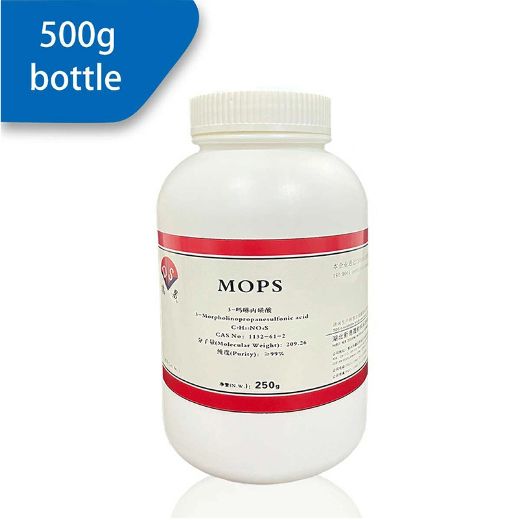
Product packaging
MOPS buffer plays an important role in electrophoresis experiments, and its pH stability directly affects the experimental results. By understanding the specific manifestations of the impact of pH changes in MOPS buffer on electrophoresis and adopting methods to maintain its pH stability, the success rate of electrophoresis experiments can be significantly improved.
Desheng is a manufacturer of MOPS buffer solutions, which not only has rich experience and technical accumulation, but also is committed to providing high-quality biological buffer products for researchers with stable supply and affordable prices. If you have any relevant intentions, please feel free to click on the website to inquire about details and purchase at any time!
Contact details
Contact number
Address: C8, Guanggu United Science and Technology City, Ezhou City, Hubei Province
Fax:0711-3704 589
Follow us
