


Which is the best choice between PIPES buffer and HEPES buffer
Release time:
2024-07-07
In biochemical and molecular biology experiments, there are various types of buffer solutions. They can stabilize the pH value of the solution, ensure the stability of the experimental environment, and thus ensure the experimental results. PIPES and HEPES buffer are two very important buffering agents in commonly used buffer solutions. Although they have similar functions in certain aspects, they all have their own characteristics and advantages. Below, we will compare the performance and application of PIPES and HEPES buffer solutions in detail, to help you make an ideal choice in the experiment.
PIPES buffer solution
1. PIPES performance characteristics:
(1) PH buffer range: 6.1-7.5
(2) Solubility: insoluble in water, soluble in NaOH aqueous solution
(3) Metal ion compatibility: does not form stable complexes with most metal ions, suitable for solution systems containing metal ions
(4) Free radical formation: PIPES can form free radicals, so it is not suitable for application in redox systems.

PIPES buffer
2. PIPES application areas:
(1) Phosphate cellulose chromatography: used for purifying microtubule proteins.
(2) Gel filtration method: used to purify recombinant GTP binding proteins ARF1 and ARF2.
(3) Escherichia coli crystalline transketolase: used as a buffer.
(4) Cation exchange chromatography: suitable for low concentration use, as PIPES has high ion strength and pKa values are concentration dependent.
Due to its ability to form free radicals, PIPES buffer is not suitable for use in redox systems. Meanwhile, low concentration PIPES buffer should be used in cation exchange chromatography to avoid the influence of high ion strength.
HEPES buffer solution
1. HEPES performance characteristics:
(1) PH buffer range: 6.8-8.2
(2) Solubility: soluble in water
(3) Metal ion compatibility: does not form stable complexes with metal ions and usually does not interfere with biochemical processes
(4) Usage concentration: The final concentration is 10-50 mmol/L, and generally, the buffer capacity can be achieved by containing 20 mmol/L HEPES in the culture medium
2. HEPES application field
(1) Cell culture medium: commonly used in cell culture media for various types of organisms.
(2) Protein research: used as binding buffer and eluent in cation exchange chromatography.
(3) RNA research: reaction buffer, pre hybridization buffer, hybridization buffer used for separating and analyzing RNA nuclear components, as well as 3 '- terminal labeling of RNA and T4RNA ligase.
(4) Diagnostic kit: used in biochemical diagnostic kits, DNA/RNA extraction kits, and PCR diagnostic kits.
HEPES interferes with the reaction between DNA and restriction enzymes, and is not suitable for Lowry's method for determining protein content. Therefore, the use of HEPES should be avoided in these applications.
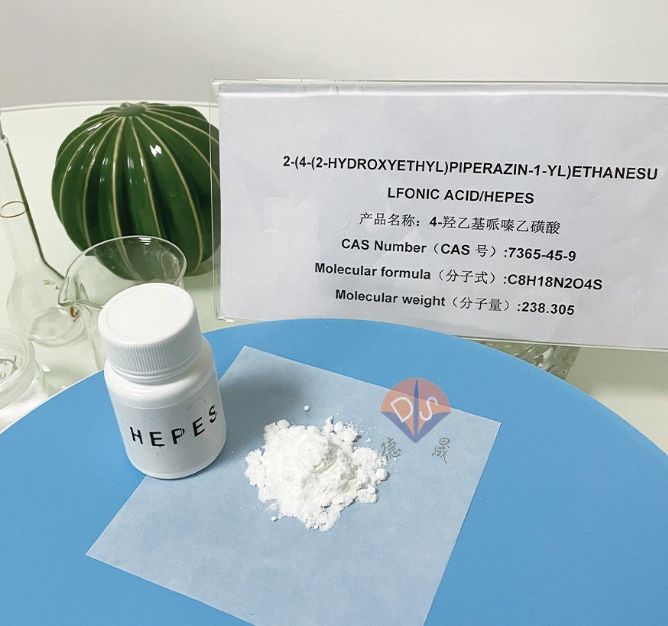
HEPES buffer
Comparison between PIPES and HEPES
1. Solubility: PIPES is insoluble in water and needs to be soluble in NaOH aqueous solution. And HEPES has good water solubility, which makes it more convenient in experiments that require aqueous solutions.
2. Buffer range: The pH buffer range of PIPES is 6.1-7.5, which tends to be acidic to neutral; The pH buffering range of HEPES is 6.8-8.2, leaning towards neutral to alkaline. When selecting a buffer, it should be based on the pH range required for the experiment.
3. Metal ion compatibility: Both do not form stable complexes with metal ions and are suitable for solution systems containing metal ions. However, PIPES is not suitable for use in redox systems when forming free radicals, while HEPES does not interfere with biochemical processes in most cases.
4. Application difference: PIPES is suitable for experiments that need to be conducted within a lower pH range, such as purification of microtubule proteins and crystallization of E. coli transketolase. HEPES is more suitable for cell culture, RNA research, and the application of diagnostic kits, especially when water-soluble buffers are needed.
How to choose PIPES and HEPES buffer solutions
1. PH range: Select a suitable buffer solution based on the pH range required for the experiment.
2. Solubility: If the experiment needs to be conducted in aqueous solution, HEPES is preferred.
3. Metal ion compatibility: If the experimental system contains metal ions, choose a buffer solution that does not form complexes with metal ions.
4. Experimental type: Select appropriate buffer solution according to the specific experimental requirements. For example, in cell cultures that require long-term stable pH, choosing HEPES is more appropriate; In experiments that need to avoid free radical formation, avoid using PIPES.

Product packaging
PIPES and HEPES buffer solutions each have their own advantages and application areas in biochemical and molecular biology experiments. Choose them, first understand their performance, and then judge based on your own experimental requirements. As a manufacturer of PIPES and HEPES, Desheng has a raw material purity of 99%, convenient transportation and storage, and affordable prices. No matter what type you need, it can meet your requirements and provide stable supply. If you are interested, please click on the website to inquire about details!
Previous page
Previous page
Contact details
Contact number
Address: C8, Guanggu United Science and Technology City, Ezhou City, Hubei Province
Fax:0711-3704 589
Follow us
