


Preparation of Gold Nanoparticles by HEPES NaOH Reduction Method
Release time:
2024-06-05
Nowadays, with the rapid development of nanotechnology, gold nanoparticles have shown broad application prospects in biomedical, catalytic, sensing and other fields due to their special physical and chemical properties. However, the environmentally friendly preparation of gold nanoparticles has always been a focus of attention for researchers. In recent years, the use of HEPES buffer (4-hydroxyethylpiperazine ethanesulfonic acid) to reduce excessive metals at specific pH values has become a new research direction for the preparation of gold nanoparticles using the HEPES NaOH reduction method.
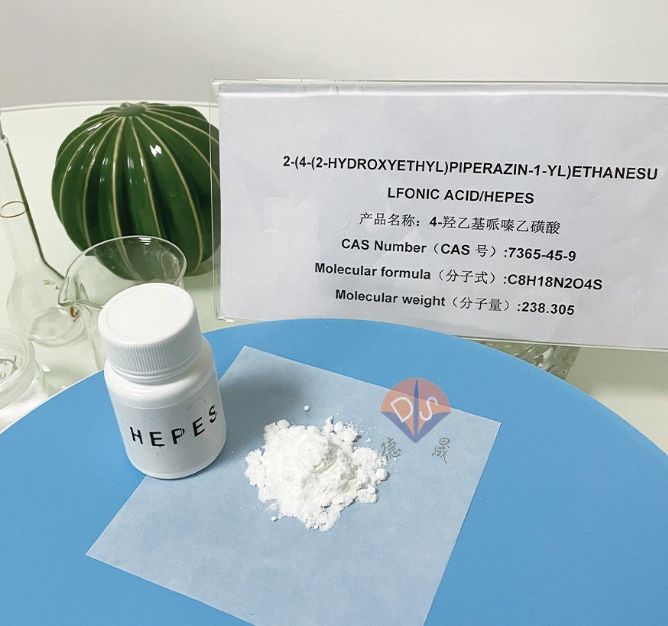
HEPES buffer
HEPES, as a commonly used biological buffer, not only has good water solubility, low adsorption, and stability in the neutral pH range, but its special chemical structure allows it to exhibit reducibility to excessive metals under specific conditions. This characteristic provides a new approach for the preparation of gold nanoparticles, and using the HEPES NaOH reduction method to prepare gold nanoparticles is an environmentally friendly new approach.
In the HEPES NaOH reduction method, a specific concentration of HEPES buffer is first prepared, and the pH value of the solution is controlled by adjusting the amount of NaOH added. At an appropriate pH value, HEPES can reduce gold ions in chloroauric acid (HAuCl4), thereby generating gold nanoparticles. This method is easy to operate, has a fast reaction speed, and due to the low adsorption of HEPES, it can reduce the pollution of gold nanoparticles and ensure the purity of the product. Compared with traditional preparation methods, the HEPES NaOH reduction method has the following advantages:
High efficiency: Due to the strong reducibility of HEPES to gold ions at specific pH values, this method can complete the preparation of gold nanoparticles in a short time, greatly improving production efficiency.
Environmental friendliness: This method does not require the use of toxic and harmful reducing agents such as sodium borohydride, making it environmentally friendly and in line with the development trend of green chemistry.
Easy control: By adjusting the pH and concentration of HEPES buffer, accurate control of the particle size and morphology of gold nanoparticles can be achieved, meeting the application needs of different fields.
In addition, due to the excellent performance of HEPES in the neutral pH range, its pKa value is close to the physiological pH value, making this method have broad application prospects in the biomedical field. For example, in fields such as carriers and biosensors, the particle size and morphology of gold nanoparticles have a significant impact on their performance. The HEPES NaOH reduction method can be used to prepare gold nanoparticles with specific particle sizes and morphologies, thus meeting the application requirements in these fields.

Product packaging
In summary, the preparation of gold nanoparticles by the HEPES NaOH reduction method is not only simple to operate, fast in reaction, and easy to control, but also has fewer by-products and is environmentally friendly. It has broad application prospects and huge market potential. The biological buffering agent products such as HEPES produced and developed by Desheng have not only been widely praised in the domestic market, but also exported overseas, winning the trust of customers. Welcome to order and consult!
Contact details
Contact number
Address: C8, Guanggu United Science and Technology City, Ezhou City, Hubei Province
Fax:0711-3704 589
Follow us
