


Awakening Health Signals: The Core Value and Application Expansion of Urinase in In Vitro Diagnosis
Release time:
2025-12-30
In the field of clinical biochemical testing, enzymes, as key biocatalysts, not only drive efficient reactions, but also become the core tool for achieving precise quantitative analysis. Uricase (EC 1.7.3.3), also known as uric acid oxidase, is a type of enzyme that can specifically catalyze the oxidation and decomposition of uric acid. It plays an irreplaceable role in the diagnosis and monitoring of uric acid metabolism related diseases and is widely used in various fields such as medical testing, automated analysis, and industrial process monitoring.
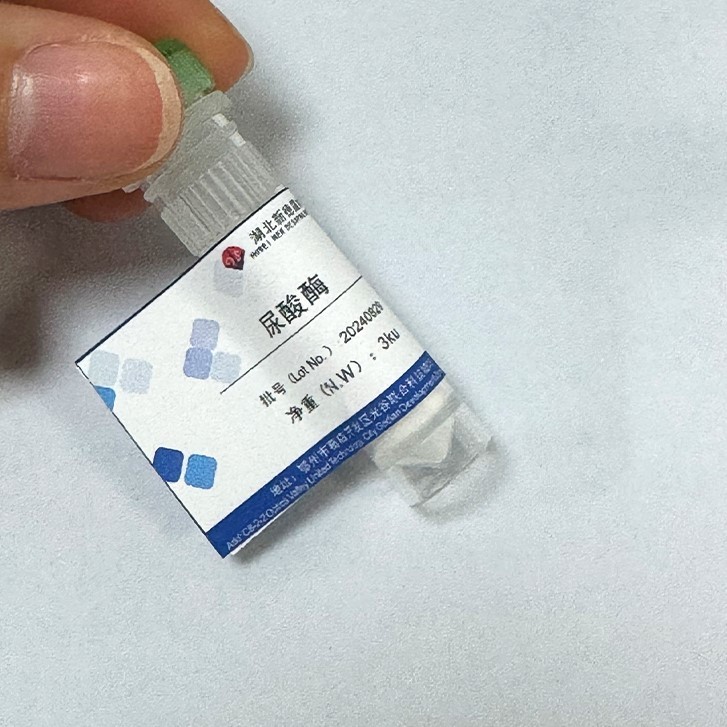
Urinase
The core mechanism of action of uricase
Urinase can catalyze the oxidation reaction between uric acid and oxygen, producing allantoin, carbon dioxide, and hydrogen peroxide (H ₂ O ₂). This reaction has high specificity and almost no cross reaction with other serum components, providing an ideal biochemical basis for quantitative detection of uric acid.
In practical detection systems, the coupling reaction method is usually used: the generated H ₂ O ₂ reacts with chromogenic substrates (such as 4-aminoantipyrine and phenolic compounds) under the catalysis of peroxidase (POD) to generate red quinone imine substances. By measuring their absorbance changes at wavelengths of 500-550 nm, the concentration of uric acid in the sample can be calculated. This detection principle has been widely used for the determination of uric acid content in serum, plasma, and urine samples, and is an important basis for evaluating hyperuricemia, gout, renal dysfunction, and metabolic syndrome.
The key role of uricase in clinical testing kits
In the formula design of uric acid detection kit, uricase is the core component that determines the detection performance. Its catalytic efficiency, specificity, stability, and anti-interference ability directly affect the sensitivity, linear range, and repeatability of the reagent. High quality uricase can ensure efficient reaction in complex sample matrices, reducing the occurrence of false positive or false negative results. Especially in samples with high blood lipids, hemolysis, or jaundice, if the purity of the enzyme is insufficient or the activity is unstable, it may lead to delayed reactions or signal drift, affecting clinical judgment. Therefore, selecting high purity, high activity, and low impurity uricase raw materials is the key to ensuring the stability of reagent performance.
Expanding Applications: From Biochemical Analysis to Industrial Process Monitoring
In addition to clinical diagnosis, uricase is also widely used in automated biochemical analysis platforms. In large hospitals and testing centers, biochemical analyzers need to complete large-scale sample testing in a short period of time, which places higher demands on the stability, reaction speed, and batch consistency of enzymes in the reagents. Urinase exhibits good compatibility in such systems and can quickly catalyze under standard reaction conditions at 37 ℃, meeting the requirements of high-throughput and high-efficiency detection.
Hubei Xindesheng: A reliable supplier of high-quality uricase
Hubei Xindesheng Biotechnology Co., Ltd. focuses on the research and production of enzymes for in vitro diagnostics. The uricase produced by the company adopts a multi-stage protein purification process to ensure that the product has high specific activity, high purity, and excellent batch stability. It is suitable for various buffer systems and exhibits good catalytic kinetic performance under 37 ℃ reaction conditions. If you need detailed technical parameters or free samples of Hubei Xindesheng uricase products, please feel free to contact us immediately. We will provide you with professional product support and customized solutions.
Contact details
Contact number
Address: C8, Guanggu United Science and Technology City, Ezhou City, Hubei Province
Fax:0711-3704 589
Follow us
