


Abnormal turbidity and inactivation of enzyme preparations? Hubei Xindesheng analyzes the root cause and rescue plan for you
Release time:
2025-12-24
In the precise world of life science research and biotechnology production, enzyme preparations, like efficient and specific "biocatalysts," are the core driving force behind countless experimental reactions and production processes. However, when these tiny 'capable generals' exhibit abnormalities, it not only leads to the invalidation of valuable experimental data, but may also result in significant economic cost waste. Identifying abnormal characteristics of enzyme preparations and taking correct and effective remedial measures is a crucial skill for every researcher and producer.
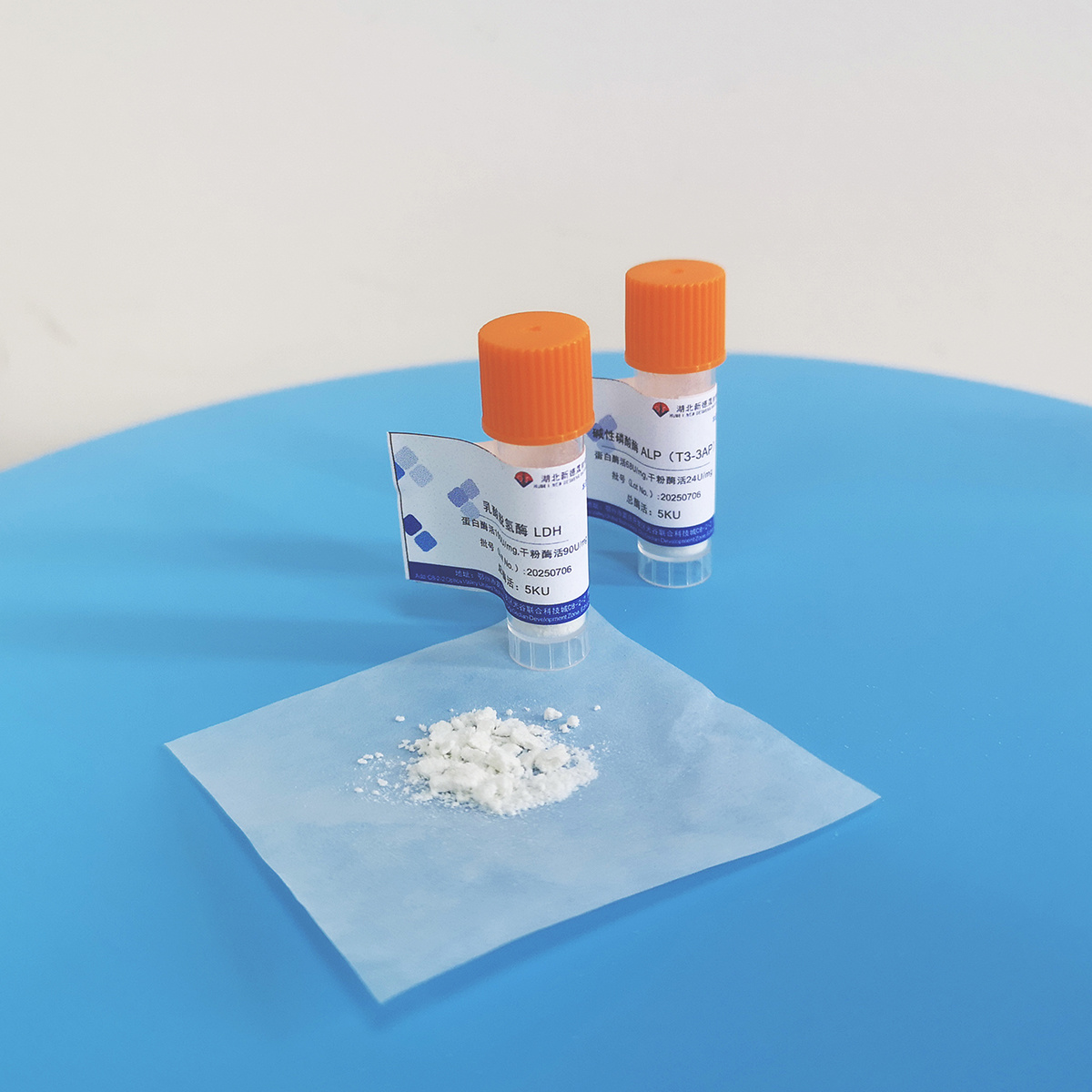
enzyme preparations
1、 Abnormal triad: cloudy, flocculent, and inactive
The abnormalities of enzyme preparations usually have three significant characteristics, which are like alarm signals, indicating that there is a problem with the stability of the product.
Firstly, a more intuitive warning is the appearance of turbidity or flocculent substances in the reconstituted liquid. Pure enzyme solution should be clear and transparent in an ideal state. Once cloud like turbidity or obvious flocculent or granular precipitation appears, it is highly likely that the enzyme protein itself has undergone denaturation, aggregation, or precipitation. This is usually due to improper transportation and storage (such as repeated freeze-thaw cycles, temperature fluctuations), excessive reconstitution operations, or sudden changes in solution environment (such as pH value, ionic strength) that disrupt the chemical bonds that maintain the three-dimensional structure of proteins.
Secondly, the core issue that follows closely is the sharp drop in catalytic efficiency. Even if there is only a slight change in the appearance of the solution, its key biological activity - the ability to catalyze specific chemical reactions - may be significantly reduced or even completely lost. Enzyme inactivation means that the reaction rate in the experiment is abnormally slow, the substrate cannot be effectively converted, and ultimately leads to the failure of the entire experimental system. Appearance abnormalities and loss of activity often occur together, pointing to the same core problem: the spatial conformation of enzyme proteins has been disrupted, and their active centers cannot bind to substrates normally.
2、 Mending the Lost Sheep: Scientific Remediation and Active Rescue Strategies
Do not easily discard the entire tube of expensive enzyme preparations when faced with abnormalities that have already occurred. A scientific "diagnosis and treatment" plan may be able to recover most of its value.
Core remedial measures: Re dissolution and filtration of high salt buffer solution. As indicated, using a buffer solution containing 200mM NaCl for reconstitution is a highly effective strategy. The scientific principle is that the appearance of flocculent substances in a solution is often due to non-specific aggregation between protein molecules caused by hydrophobic interactions. A high ion strength of appropriate concentration (such as Na ⁺ and Cl ⁻ provided by NaCl) can neutralize some of the charges on the surface of protein molecules, weaken the electrostatic repulsion between protein molecules, but more importantly, it can compete with proteins for water molecules, destroy the hydration layer on their surface, and promote the weakening of hydrophobic interactions, making it easier for the aggregated denatured proteins to disperse.
3、 Preventive measures: Ensuring the quality of enzyme preparations from the source
Of course, mastering remedial techniques can reduce losses, but preventing problems from occurring is the top priority. This places high demands on the technical processes, quality control systems, and production environment of enzyme preparation manufacturers. A stable production process can ensure that each batch of products has good tolerance and consistency, avoiding problems such as reconstitution turbidity and easy deactivation from the source.
In recent years, in order to meet the growing demand for high-quality diagnostic reagents in the market, domestic enterprises have been continuously increasing investment, improving production capacity and quality standards. We are pleased to see that Hubei Xindesheng Material Technology Co., Ltd. is actively promoting the construction of a new factory area in Huanggang, Hubei. The construction of this modern production base will rely on more advanced process equipment, stricter clean environment, and more complete quality control processes, focusing on the production of various diagnostic reagent raw materials including high-performance enzyme preparations, high-end biological buffering agents, etc., striving to break the dependence on imports and promote the localization and substitution of key raw materials.
Contact details
Contact number
Address: C8, Guanggu United Science and Technology City, Ezhou City, Hubei Province
Fax:0711-3704 589
Follow us
