


Tris Buffer Advanced Guide: How to Adjust Ionic Strength
Release time:
2025-11-15
Basic characteristics and application scenarios of Tris buffer
Tris base (trihydroxymethylaminomethane) is a widely used buffer in biological experiments due to its excellent buffering capacity, low ionic strength, and stable pH range (approximately 7.0-9.0). It plays an irreplaceable role in molecular biology, protein purification, electrophoresis, and enzyme reactions. The preparation of Tris buffer is relatively simple, but if it is necessary to adjust its ionic strength, more precise operation and understanding are required.
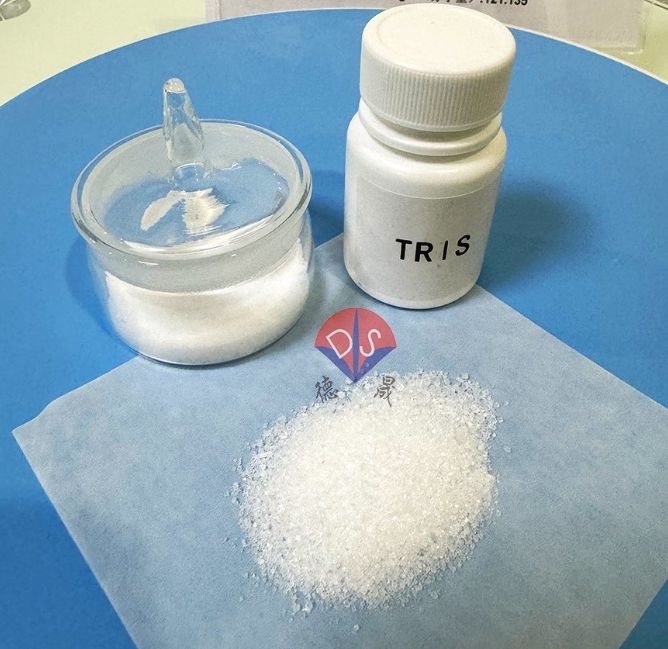
TRIS base powder
What is ionic strength
It is an important parameter for measuring the influence of ion concentration and charge in a solution, and its calculation formula is: I=∑ (c_i × z_i ²), where c_i is the ion concentration and z_i is the ion charge number. Tris itself has a certain ionic strength, but its buffering ability mainly comes from its molecular structure. In practical applications, if it is necessary to change the ionic strength of the buffer, it cannot be simply achieved by adjusting the amount of HCl, as this will directly affect the pH value of the buffer.
How to adjust the ion strength of Tris
There are usually two ways to achieve accurate control of the ion strength of Tris buffer:
1. Increase ion strength:
Strong electrolytes such as NaCl (or KCl) can be added to Tris solution. Due to the sufficient dissociation of these salts in water, their ion concentration can be accurately calculated, and therefore the control of ion strength can be achieved by weighing the amount added. For example, if it is necessary to increase the ion strength to 0.15 M, NaCl can be added proportionally, while paying attention to adjusting the concentration of Tris to maintain the desired pH.
2. Reduce ion strength:
If it is necessary to reduce the ionic strength, it cannot be achieved by adding electrolytes, as this will introduce additional ions and instead increase the ionic strength. At this point, the ion strength can be reduced by appropriately diluting the Tris solution without affecting its buffering capacity. Although this method is simple, it requires re measuring the pH value after dilution to ensure that it is within the target range.
Key techniques for preparing high-precision Tris buffer solution
In practical operation, preparing Tris buffer solutions with different ion strengths requires certain experimental skills and theoretical foundations. Firstly, high-purity Tris and salt reagents should be selected to ensure that impurities have a minimal impact on the experimental results. Secondly, use a pH meter to accurately measure the pH value and avoid a decrease in buffering capacity due to pH fluctuations. During the experimental process, the operational details of each step should be recorded for subsequent repetition and optimization.

Product packaging
Choose a professional Tris supplier
In the laboratory, although the preparation of Tris buffer may seem simple, achieving high precision and stability still requires high-quality raw materials and professional technical support. Hubei Xindesheng, as a professional Tris manufacturer in China, focuses on providing high-purity and highly stable biological buffer products. The company has a sound quality control system and rich research and development experience, which can be customized according to customer needs, providing reliable guarantees for experiments and production.
Contact details
Contact number
Address: C8, Guanggu United Science and Technology City, Ezhou City, Hubei Province
Fax:0711-3704 589
Follow us
