


From Preparation to Preservation: A Scientific Guide to NSP-SA-NHS Labeling Operations
Release time:
2025-10-01
Among numerous chemiluminescence reagents, acridine ester derivatives have attracted much attention due to their advantages of emitting light without enzyme catalysis, low background signal, and high luminescence efficiency. Among them, NSP-SA-NHS is widely used for efficient coupling of biomolecules such as proteins, antibodies, and nucleic acids. This article will focus on the labeling process of NSP-SA-NHS, analyze its key operational points, and assist scientific research and testing workers in achieving more efficient and stable labeling effects.
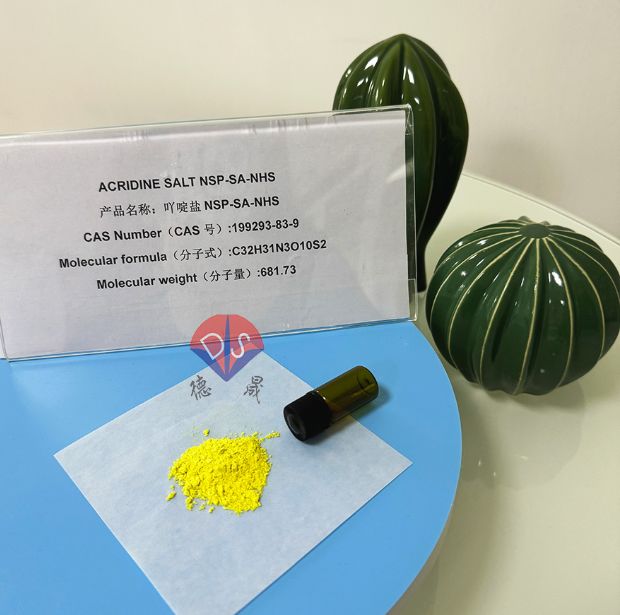
NSP-SA-NHS
1、 Molecular Structure of NSP-SA-NHS
The molecular structure of NSP-SA-NHS consists of three core functional modules:
Acridine ring: responsible for chemiluminescence and is the core of signal output;
NHS ester group: can undergo efficient amidation reaction with the primary amino group (- NH ₂) on the target molecule, achieving covalent connection;
Sulfonic acid modification (NSP): significantly improves water solubility, reduces aggregation during labeling, enhances reaction efficiency and product stability.
2、 Preparation before marking
The mark of success begins with sufficient preparation in the early stages. Firstly, the purity of the target protein or antibody and the buffer system are crucial. If the molecule to be labeled is dissolved in a buffer containing primary amines (such as Tris, glycine), it must be replaced with an amine free buffer through dialysis or desalination column in advance, otherwise free amines will compete with NHS esters for reaction, greatly reducing the labeling efficiency.
Secondly, the protein concentration should be controlled within a reasonable range. A low concentration can lead to a decrease in labeling rate, while a high concentration can easily cause intermolecular cross-linking or precipitation. It is recommended to use UV spectrophotometry to accurately determine protein concentration in order to eliminate nucleic acid contamination.
3、 Optimization of reaction conditions
The labeling reaction of NSP-SA-NHS belongs to nucleophilic addition reaction, and its efficiency is highly dependent on the precise regulation of reaction conditions.
The pH value should be controlled within a certain range as needed: an appropriate pH range can enhance its nucleophilicity, thereby improving the reaction rate with NHS esters. A pH that is too low can inhibit the reaction, while a pH that is too high may lead to hydrolysis of the acridine ester itself, affecting its luminescence performance.
The recommended reaction temperature is 4-25 ℃: low temperature (such as 4 ℃) can slow down hydrolysis side reactions and is suitable for heat sensitive proteins; The reaction at room temperature is faster and suitable for molecules with stronger stability. Avoid prolonged high-temperature incubation.
The molar ratio needs to be scientifically set: usually, the molar ratio of NSP-SA-NHS to the target protein is controlled between 3:1 and 10:1. The proportion is too low and the labeling is insufficient; Excessive labeling may lead to over labeling, affecting protein activity or increasing non-specific signals. The proportion can be optimized through pre experiments.
4、 Purification and preservation
After the reaction is terminated, it is necessary to remove the unconjugated acridine ester small molecules by gel filtration chromatography or ultrafiltration to avoid background signal interference. The purified label should usually be added to a blocking buffer for blocking reaction, stored in the dark to prevent degradation of luminescent groups.

Product packaging
As a professional supplier of chemiluminescence reagents in China, Hubei Xindesheng focuses on the research and production of acridine ester series products. Its NSP-SA-NHS products are known for their high purity, batch stability, and good water solubility. The company provides professional technical support and customized services to help customers optimize marking processes, improve detection sensitivity and repeatability.
Contact details
Contact number
Address: C8, Guanggu United Science and Technology City, Ezhou City, Hubei Province
Fax:0711-3704 589
Follow us
