


PIPES with piperazine-1,4-diethylsulfonic acid assists in the innovation of inkjet ink technology
Release time:
2025-03-30
In today's rapidly developing technological era, the progress of every technology cannot be separated from the pursuit of details. Especially in the field of fine chemistry, a small change in molecular structure can lead to a huge leap in performance. Next, we will focus on a compound called piperazine-1,4-diethylsulfonic acid (PIPES buffer) and explore how it plays an important role in the field of ink, especially as a pH regulator, bringing revolutionary changes to inkjet ink technology.
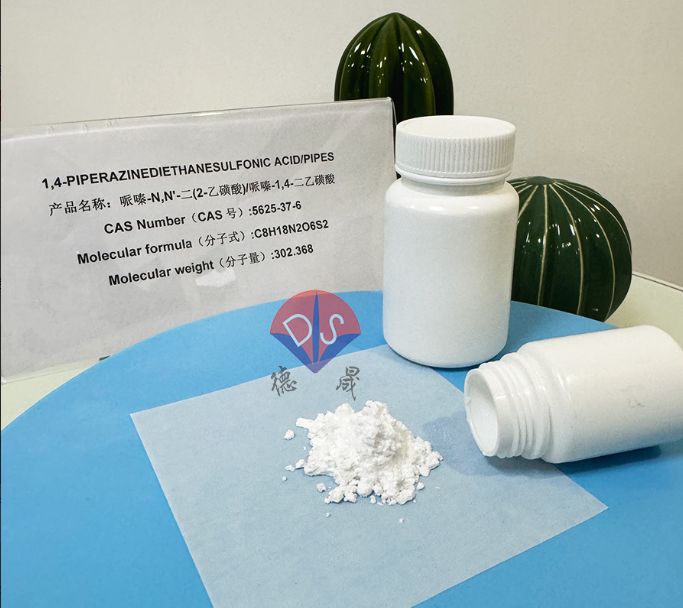
PIPES powder
PIPES: Cross border application of biological buffering agents
Let's first have a brief understanding of piperazine-1,4-diethylsulfonic acid PIPES. Its CAS number is 5625-37-6. As a biological buffering agent, PIPES is widely used in laboratory research and development processes as well as chemical production. It has good water solubility and thermal stability, and can maintain the stability of the solution over a wide pH range. However, the application of PIPES goes far beyond that. In recent years, with the development of ink technology, scientists have begun to explore the potential value of PIPES in the field of ink.
Challenges faced by ink technology
Traditional inkjet inks face many challenges in their use, among which one of the most prominent issues is the surface tension of the ink. When adding organosilicon surfactants to ink, although it can effectively reduce the initial surface tension of the ink and improve its flowability, after long-term storage, the surface tension of the ink will gradually increase, leading to a decrease in filling and ejection stability, which in turn affects print quality. This issue has become an important bottleneck restricting the further development of inkjet ink technology.
Addition of PIPES: Accurate control of pH value
Scientists have proposed a novel inkjet ink composition for sublimation transfer printing to address the aforementioned issues. This composition not only contains dispersed dyes and dispersed resins, but also specially incorporates organosilicon surfactants and solubilizers. More importantly, by accurately controlling the pH value and adding an appropriate amount of piperazine-1,4-diethylsulfonic acid PIPES to the ink composition, the problem of changes in the physical properties of the ink during long-term storage has been successfully solved.
Advantages of joining PIPES
After adding piperazine-1,4-diethylsulfonic acid PIPES, this inkjet ink composition exhibits the following significant advantages:
Inhibition of odor in printing and dyeing: The addition of piperazine-1,4-diethylsulfonic acid PIPES effectively reduces the odor generated by ink during the printing process.
Excellent filling and spray stability: Even after long-term storage, ink containing piperazine-1,4-diethylsulfonic acid PIPES can still maintain good fluidity and stability.
Storage stability: Thanks to the effective pH regulation of piperazine-1,4-diethylsulfonic acid PIPES, this ink composition exhibits excellent performance under different storage conditions, extending the product's service life.

Product packaging
By ingeniously applying piperazine-1,4-diethylsulfonic acid PIPES to inkjet ink technology, we not only overcome the shortcomings of traditional inks, but also open up new development directions for future ink technology. With the continuous research and technological progress of Desheng in the field of biological buffering agents, we believe that in the future, we will witness more brilliant achievements in different fields like piperazine-1,4-diethylsulfonic acid PIPES, and jointly write a new chapter in technological development.
Contact details
Contact number
Address: C8, Guanggu United Science and Technology City, Ezhou City, Hubei Province
Fax:0711-3704 589
Follow us
