


What are the analytical methods for buffer trihydroxymethyl aminomethane
Release time:
2025-03-03
In the fields of chemistry and biology, the buffering agent Tris, also known as aminobutriol, is widely used in various experiments and production processes. To ensure its quality and performance, appropriate analytical methods need to be used for testing and analysis. The following will specifically discuss the analysis method of buffer trihydroxymethylaminomethane.
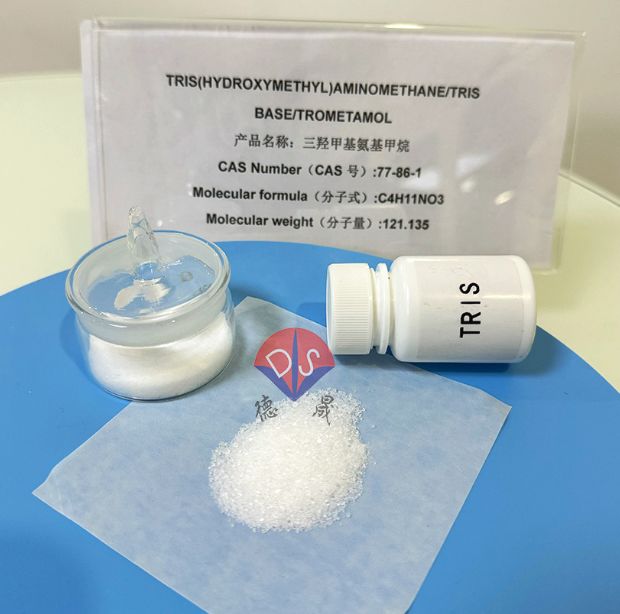
TRIS base powder
Appearance and physical property analysis
Appearance inspection: By observing the appearance of trihydroxymethylaminomethane, its quality can be preliminarily judged. Superior trihydroxymethyl aminomethane is usually a white crystalline powder with no obvious impurities or discoloration. If lumps, discoloration, or impurities are found, it may indicate a quality issue with the product.
Solubility test: Trihydroxymethyl aminomethane has good solubility in water. The solubility of trihydroxymethyl aminomethane can be determined by adding a specific amount to water and observing its dissolution. If the dissolution is rapid, it indicates that the product has good solubility; If there is difficulty or insufficient dissolution, further inspection of the product quality may be necessary.
Melting point determination: Melting point is one of the important physical properties of a substance. A melting point analyzer can be used to measure the melting point of trihydroxymethylaminomethane. The melting point of reliable trihydroxymethylaminomethane is usually between 168-172 ℃. If the melting point deviation is large, it may indicate a problem with the purity of the product.
Chemical property analysis
PH measurement: Trihydroxymethyl aminomethane is a commonly used buffering agent, and its pH value has a significant impact on its performance. A pH meter can be used to measure the pH value of trihydroxymethylaminomethane solution. The pH value of trihydroxymethylaminomethane will vary at different concentrations and temperatures. Generally speaking, its pH value is between 7.0-9.0. If the pH value exceeds this range, it may be necessary to check the quality of the product or adjust the usage conditions.
Purity analysis: Purity is one of the important indicators for measuring the quality of trihydroxymethyl aminomethane. Multiple methods can be used to analyze its purity, such as liquid chromatography (HPLC), gas chromatography (GC), infrared spectroscopy (IR), etc.
Liquid chromatography: HPLC is a commonly used analytical method that can accurately determine the purity of trihydroxymethylaminomethane. By injecting the sample into the chromatographic column and utilizing the difference in distribution coefficients between different substances in the stationary and mobile phases for separation, the content of each component is detected by a detector. HPLC has the advantages of high separation efficiency, fast analysis speed, and high sensitivity.
Gas chromatography: GC is mainly used for analyzing volatile and semi volatile substances. For trihydroxymethylaminomethane, it can be converted into volatile derivatives for analysis. GC has the advantages of strong separation ability, fast analysis speed, and high sensitivity, but it is not suitable for some non-volatile or thermally unstable substances.
Infrared spectroscopy: IR is a method of analyzing the absorption characteristics of infrared light by substances. By measuring the infrared spectrum of trihydroxymethylaminomethane, its molecular structure and functional groups can be determined, thereby determining its purity. IR has the advantages of simple operation, speed, and no need for sample pretreatment, but its sensitivity for detecting low levels of impurities is relatively low.
Impurity analysis: In addition to purity analysis, it is also necessary to detect impurities in trihydroxymethylaminomethane. Common impurities include heavy metal ions, organic impurities, moisture, etc.
Heavy metal ion detection: Atomic absorption spectroscopy (AAS), inductively coupled plasma mass spectrometry (ICP-MS) and other methods can be used to detect heavy metal ions in trihydroxymethylaminomethane. These methods have the advantages of high sensitivity and good selectivity, and can detect trace amounts of heavy metal ions.
Moisture determination: Karl Fischer method, dry weight loss method, and other methods can be used to determine the moisture content in trihydroxymethylaminomethane. Excessive moisture content may affect the performance and stability of trihydroxymethylaminomethane, therefore strict control is required.
Biological property analysis
Cell toxicity testing: If trihydroxymethyl aminomethane is used in the biomedical field, it needs to undergo cell toxicity testing to ensure that it is not toxic to cells. Cell culture method can be used to co culture cells with different concentrations of trihydroxymethyl aminomethane solution, and observe the growth and morphological changes of cells. If the cells grow well and have normal morphology, it indicates that trihydroxymethyl aminomethane has no cytotoxicity; If cells exhibit phenomena such as death or deformation, further inspection of product quality or adjustment of usage concentration may be necessary.
Biocompatibility testing: For trihydroxymethyl aminomethane used in the biomedical field, biocompatibility testing is also required, which can be conducted through animal experiments or in vitro simulation experiments. For example, trihydroxymethyl aminomethane can be implanted into animal bodies to observe its stimulation and response to tissues; Alternatively, contact trihydroxymethyl aminomethane with tissues or cells of the organism and observe its effects on the tissues or cells.

Product packaging
The analysis methods of buffer trihydroxymethylaminomethane include appearance and physical property analysis, chemical property analysis, and biological property analysis. By using these analytical methods, the quality and performance of trihydroxymethylaminomethane can be comprehensively tested and evaluated. Hubei Xindesheng Material Technology Co., Ltd., as a research and development manufacturer of biological buffering agents, has a purity of 99% for its trihydroxymethyl aminomethane product, good water solubility, and small inter batch differences. It can be packaged and samples can be provided as needed. All performance indicators meet the standards. If you have purchasing intentions, please feel free to click on the website to inquire about details and purchase at any time!
Contact details
Contact number
Address: C8, Guanggu United Science and Technology City, Ezhou City, Hubei Province
Fax:0711-3704 589
Follow us
