


TRIS modified PVA: ushering in a new era of thermoplastic processing
Release time:
2025-01-19
Polyvinyl alcohol (PVA), as a common polymer material, has a wide range of applications in packaging, textile, construction and other fields. However, traditional PVA is limited in its application in thermoplastic processing due to its high crystallinity and melting point. To solve this problem, scientists are constantly exploring new modification methods in order to endow PVA with better thermoplastic processing properties while maintaining its original excellent properties.
As a polyhydroxy compound, TRIS's unique molecular structure provides new possibilities for the modification of PVA. Researchers have found that introducing the multi hydroxyl structure of TRIS base onto PVA molecular chains can form new hydrogen bonds with the original hydroxyl groups of PVA. This new hydrogen bonding not only helps to reduce the damage to the original hydrogen bonds of modified PVA, but also stabilizes the molecular structure of PVA to a certain extent. This discovery provides a theoretical basis for TRIS modified PVA and also points out the direction for subsequent experimental research.
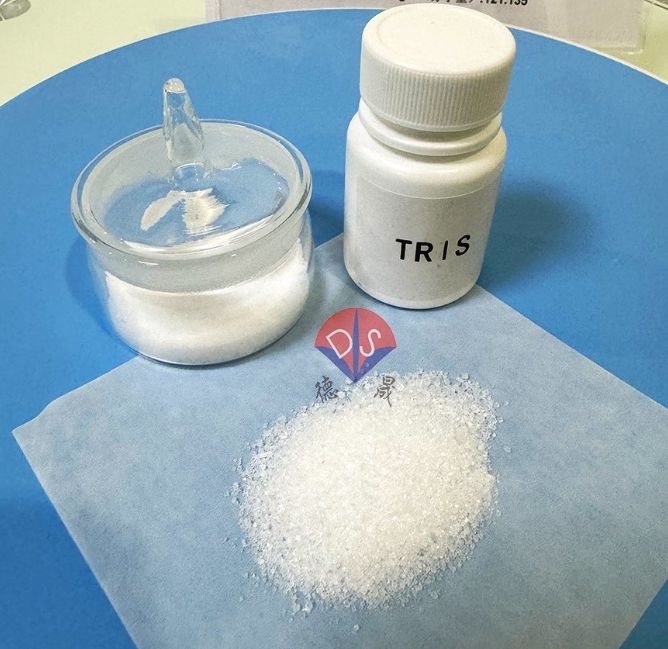
TRIS base powder
The introduction of TRIS (trihydroxymethylaminomethane) has a significant impact on the structure and properties of polyvinyl alcohol (PVA). The following is a detailed analysis.
1、 The impact on PVA structure
Chemical structural changes: The multi hydroxyl structure of TRIS can interact with the hydroxyl groups of PVA to form new hydrogen bonds. This interaction not only reduces the damage to the original hydrogen bonds of PVA during the modification process, but also changes the molecular structure of PVA.
Reduced regularity of molecular chains: The introduction of TRIS disrupts the regularity of PVA molecular chains, resulting in a significant decrease in the crystallinity and melting point of PVA. This is because the molecular structure of TRIS increases the distance between PVA molecules and weakens the crystallization ability of PVA.
2、 The impact on PVA properties
Improved thermal stability: The introduction of TRIS can enhance the thermal stability of PVA. This is because TRIS can inhibit the removal reaction between adjacent hydroxyl groups, thereby improving the thermal stability of PVA. Meanwhile, the introduction of TRIS also broadens the thermal processing window of PVA, allowing it to undergo thermoplastic processing over a wider temperature range.
Changes in mechanical properties: The mechanical properties of PVA modified with TRIS have been improved. Specifically, it manifests as a decrease in tensile strength but an increase in elongation at break. This is because the introduction of TRIS reduces the crystallinity of PVA, increases the activity of PVA molecular chains, and thus improves its elongation at break.
Improvement of melt processing performance: The introduction of TRIS reduces the melting point of PVA and widens the melting limit, thereby improving the melt processing performance of PVA. PVA modified with TRIS can achieve thermoplastic processing without adding any plasticizers.

Product packaging
The successful preparation and application of TRIS modified PVA not only provides a new solution for the thermoplastic processing of PVA, but also offers new ideas and methods for the modification research of polymer materials. In the future, with the continuous deepening of research and the continuous improvement of technology, TRIS modified PVA is expected to demonstrate advantages and potential in more fields. Desheng is a professional direct manufacturer of TRIS and other biological buffering agents, with a large-scale production base. If you have purchasing needs, please feel free to contact us.
Contact details
Contact number
Address: C8, Guanggu United Science and Technology City, Ezhou City, Hubei Province
Fax:0711-3704 589
Follow us
