


HEPES (4-hydroxyethylpiperazine ethanesulfonic acid): an escort for cell culture and in vitro diagnosis
Release time:
2025-01-08
HEPES (4-hydroxyethylpiperazine ethanesulfonic acid), as an important buffer in biochemical research, not only performs well in maintaining the stability of cell culture environment, but also demonstrates its application value in various in vitro diagnostic applications. This article will explore the role of HEPES in different culture media, particularly how it affects oocyte processing in zebrafish embryo development and nuclear transfer studies.
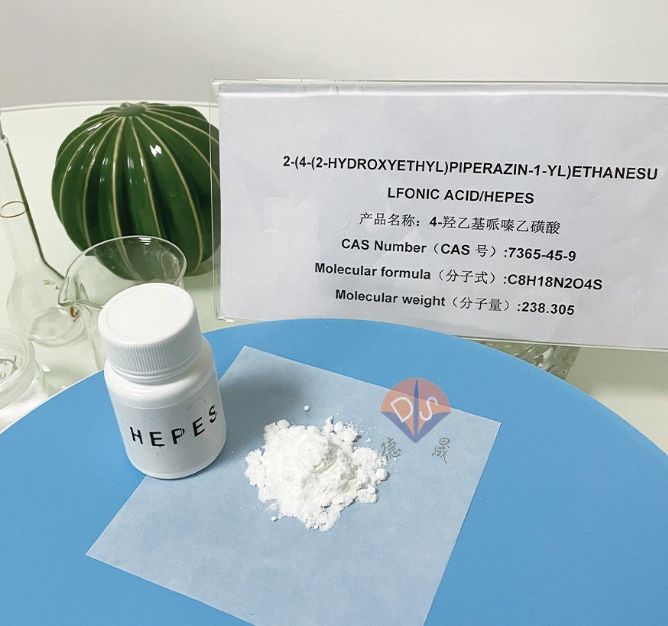
HEPES Powder
The core role of HEPES in cell culture
In cell biology research, maintaining stable cell culture conditions is the key to successful experiments. HEPES has become one of the main components of many cell culture media due to its excellent pH buffering ability. For experiments that need to be conducted in open or non closed systems, HEPES can ensure a stable pH environment even under changes in CO2 concentration. This characteristic makes HEPES particularly suitable for pH sensitive cell types such as mammalian cells, as well as research projects that require long-term maintenance of specific pH conditions.
The use of HEPES in Danieau culture medium
Zebrafish, as an important model organism, holds a significant position in developmental biology, genetics, and pharmacology research. Danieau medium is a culture medium specifically designed for zebrafish embryos, which contains HEPES added to help prevent melanin formation after the formation of gut embryos. This is not only for aesthetic considerations, but more importantly, to improve the quality of subsequent observation and imaging analysis. By inhibiting melanin deposition, researchers can obtain clearer visual effects, thereby more accurately evaluating the developmental process of zebrafish embryos and their susceptibility to external factors.
Application of HEPES in TCM199 medium
TCM199 (Tissue Culture Medium 199) is a basic culture medium widely used in various tissue culture and cell engineering operations. When it comes to nuclear transfer research, washing fresh oocytes is a crucial step. HEPES is used as a supplement for TCM199 to ensure that oocytes are not damaged during washing due to pH fluctuations. In addition, a stable pH environment helps protect cell membranes and other cellular structures from damage, which is crucial for successful nuclear transfer. The existence of HEPES ensures that oocytes can complete this critical operation under suitable conditions, thereby improving the success rate of the experiment.
HEPES supports the development of in vitro diagnostics
With the continuous advancement of in vitro diagnostic technology, the role of biological buffer HEPES has become increasingly prominent. Due to its excellent buffering performance, HEPES can provide a stable pH environment for diagnostic reagents without affecting sample integrity. This is of great significance for ensuring the accuracy of the test results. Especially when it comes to enzyme activity determination, antigen antibody reactions, and other biochemical analyses that rely on pH control, the application of HEPES can significantly improve the reliability and reproducibility of experiments.

Product packaging
HEPES has demonstrated significant value in cell culture and in vitro diagnostics due to its pH buffering ability. HEPES plays an indispensable role in supporting zebrafish embryo development research and promoting successful nuclear transfer experiments. In the future, with the further development of science and technology, Desheng New Materials has reason to believe that HEPES will continue to play an important role in life science research and promote the birth of more innovative achievements.
Contact details
Contact number
Address: C8, Guanggu United Science and Technology City, Ezhou City, Hubei Province
Fax:0711-3704 589
Follow us
