


HEPES buffer: a key role in lactate dehydrogenase detection
Release time:
2025-01-04
The Importance of HEPES in Biochemical Detection
Lactate dehydrogenase (LDH), as one of the key enzymes in the intracellular glycolysis pathway, undergoes changes in its activity under various pathological conditions. Therefore, accurate determination of LDH activity is not only of great significance for basic scientific research, but also an important tool for clinical diagnosis. In this process, selecting the appropriate buffer is one of the key factors to ensure the accuracy of the detection results. HEPES (4-hydroxyethylpiperazine ethanesulfonic acid), as a widely used biological buffer, is gradually becoming the core component of lactate dehydrogenase detection kits.
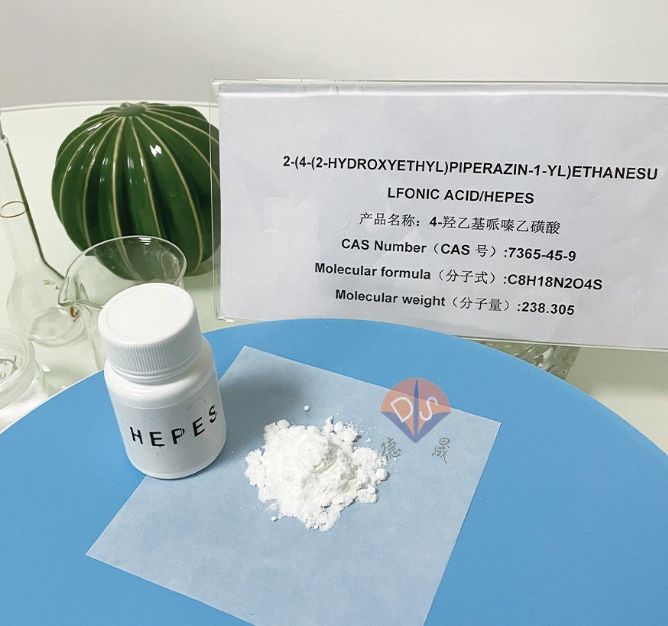
HEPES buffer powder
HEPES: Ideal biological buffering agent
HEPES is an organic weak acid with amphoteric properties, which can provide excellent buffering capacity at pH values between 6.8 and 8.2. This characteristic makes HEPES particularly suitable for biochemical reaction systems that require strict pH control, such as the detection of lactate dehydrogenase. Due to the catalytic environment of LDH typically being within this pH range, HEPES can effectively maintain the stability of reaction conditions, thereby ensuring the accuracy of enzyme activity measurement. In addition, HEPES has good water solubility and low toxicity, and does not form chelates with most metal ions, reducing the possibility of potential interference.
Reagent I and Reagent II: Design Concept of Dual Reagent System
In order to improve detection accuracy and reduce the impact of non-specific reactions, the lactate dehydrogenase detection kit adopts a dual reagent design. Reagent I contains a biological buffer HEPES, a metal ion complex, a substrate for lactate dehydrogenase reaction, a surfactant, an activator of lactate dehydrogenase enzyme activity, a preservative, and water; Reagent II consists of HEPES, nicotinamide adenine dinucleotide oxidized NAD+, surfactants, preservatives, and water. By adding different functional components separately, the system can better control the reaction conditions and reduce the interference caused by the turbidity of the sample itself. This design not only improves the stability and reliability of the detection results, but also simplifies the operation process, making clinical use more convenient and efficient.
Detection principle: scientific basis and practical application
The process of lactate dehydrogenase catalyzing the reduction of pyruvate to L-lactic acid is a reversible reaction, and when the concentration of lactic acid is high, it promotes the reverse reaction - that is, the synthesis of pyruvate from lactic acid. Under suitable pH conditions maintained in HEPES buffer, L-lactic acid reacts with NAD+to produce pyruvic acid and NADH. It is worth noting that NADH has characteristic absorbance at a wavelength of 340nm, which means that LDH activity can be quantified by monitoring changes in absorbance. The rate of increase in absorbance is directly proportional to the activity of LDH, providing a scientific basis for the rapid and simple evaluation of enzyme activity. More importantly, this method does not require pre dilution of the sample and is suitable for fully automated biochemical analyzers, improving detection efficiency.

Product packaging
The application advantages of Desheng Hepes
1. Good stability: The buffering effect provided by HEPES buffer ensures pH stability throughout the entire detection process.
2. High accuracy: By optimizing the formula and implementing strict quality control measures, consistent results can be obtained for each test.
3. Wide linear testing range: able to cover a wide range of LDH activity levels and adapt to different sample types.
4. Good repeatability: Even in the face of complex and diverse samples, it can maintain highly consistent detection performance.
5. Strong anti-interference ability: effectively resists the influence of external factors such as temperature changes or sample impurities, ensuring the authenticity of data.
6. No need for pre dilution: simplifies experimental steps, shortens detection time, especially suitable for busy clinical environments.
Previous page
Previous page
Contact details
Contact number
Address: C8, Guanggu United Science and Technology City, Ezhou City, Hubei Province
Fax:0711-3704 589
Follow us
