


Desheng's answer | What is Luminol reactant
Release time:
2024-12-16
Luminol reagent is a widely used chemical reagent in forensic science, chemiluminescence immunoassay, and scientific experiments. Due to its ability to produce significant blue fluorescence under specific conditions, luminol reagent is used for bloodstain testing, environmental pollution detection, and labeling and detection of biomolecules. This article will explore in detail the chemical properties, reaction mechanisms, application fields, and importance of luminol reactants in various scientific research.

Luminol powder
Definition and background of luminol reactants
Luminol, also known as luminescent ammonia, has the chemical name 3-aminophthalazide and the chemical formula C8H7N3O2. It is a stable chemical reagent that appears as a yellow powder at room temperature. Luminol can be traced back to 1853, when it was first synthesized, but what really made Luminol famous was after 1928 when chemists discovered its ability to emit blue light when oxidized. This discovery was quickly applied in the field of forensic science and became a tool for detecting bloodstains.
The Chemical Principle of Luminol Reaction
1. Luminescence mechanism
The luminescence principle of luminol is based on its chemical reaction with oxidants (such as hydrogen peroxide) in the presence of catalysts (such as metal ions like iron and copper). Specifically, when luminol reacts with hydroxides, a double negative ion intermediate is generated, which is then oxidized by oxygen produced by the decomposition of hydrogen peroxide to form an unstable organic peroxide. This peroxide will rapidly decompose, releasing energy and existing in the form of photons, emitting blue fluorescence.
2. The role of catalysts
Catalysts play a crucial role in the luminol reaction. Common catalysts include multivalent metal ions (such as iron, copper, cobalt) and peroxidases (such as horseradish peroxidase). These catalysts can accelerate the decomposition of hydrogen peroxide, thereby triggering the luminescent reaction of luminol. Especially in forensic medicine, the iron element in hemoglobin acts as a catalyst, allowing luminol to detect bloodstains.
The synthesis method of luminol reagent
The synthesis of luminol usually involves multiple steps, among which the more classical method is to undergo a condensation reaction between 3-nitrophthalic acid and hydrazine in a high boiling point solvent, followed by a reduction reaction to obtain it. The specific process is as follows:
1. Condensation reaction: 3-nitrophthalic acid and hydrazine undergo condensation reaction in high boiling point solvents (such as diethylene glycol), losing one molecule of water and generating 3-nitrophthalic hydrazide.
2. Reduction reaction: Using sodium hydrosulfite as a reducing agent, the nitro group in 3-nitrophthalic hydrazide is reduced to an amino group to obtain luminol.
Precautions for using luminol reagent
1. Maintaining reagent purity: The purity of luminol reagent is important for accurate analysis results. Before use, the reagent should undergo purity testing and ensure that it is stored in good conditions and has not expired.
2. Optimize experimental conditions: The luminescence reaction of luminol is influenced by various factors, such as temperature, pH value, and oxidant concentration. During the experimental process, these conditions should be optimized to obtain ideal luminescent signals and sensitivity.
3. Prevent light sensitivity: Luminol is sensitive to light, so direct exposure to strong light should be avoided during use and storage.
Common applications of luminol reactants
1. In forensic science, luminol reagent is widely used for bloodstain detection. Due to the ability of iron ions in the blood to catalyze the chemiluminescence reaction of luminol, even trace amounts of blood stains that have been washed or masked can be detected. After the luminol reagent is sprayed on the suspected bloodstain area, if there is blood present, blue fluorescence will appear to help forensic experts determine the location and range of the bloodstain.
2. Chemiluminescence immunoassay: Luminol is used in chemiluminescence immunoassay (CLIA), which is a highly sensitive detection method that diagnoses by detecting specific antigens or antibodies in the sample. Luminol is used as a chemiluminescent marker in this analytical method, and after binding with the target molecule, the concentration of the target molecule is quantitatively analyzed by detecting the luminescence intensity.
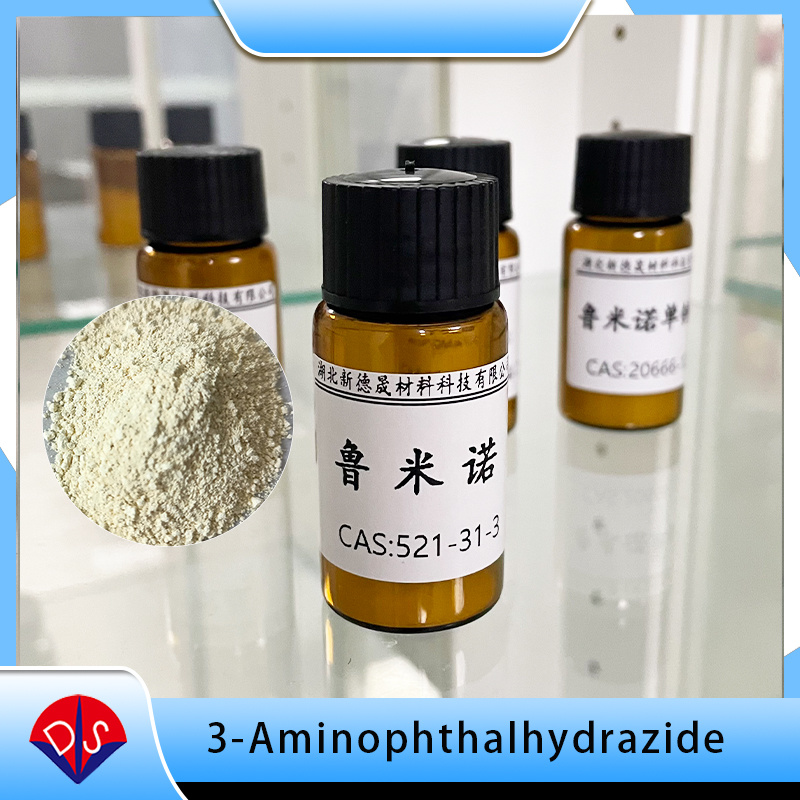
Product packaging
Luminol reagent, as an important chemiluminescence reagent, has attracted much attention due to its applications in forensic science, chemiluminescence immunoassay and other fields. As a manufacturer of luminol reactants, Desheng not only has stable luminescence performance, but also high sensitivity and low price, making it a unanimous choice for many customers. If you have any relevant intentions, please feel free to click on the website for consultation at any time!
Contact details
Contact number
Address: C8, Guanggu United Science and Technology City, Ezhou City, Hubei Province
Fax:0711-3704 589
Follow us
