


Technical Guidelines for Deshengacridine Ester Labeling Technology
Release time:
2024-10-03
Acridine ester labeling technology, as a sensitive chemiluminescence labeling method, plays an important role in modern biomedical research and diagnosis. Acridine esters can provide reliable labeling effects. The following is a technical guide for Desheng's acridine ester labeling technology.
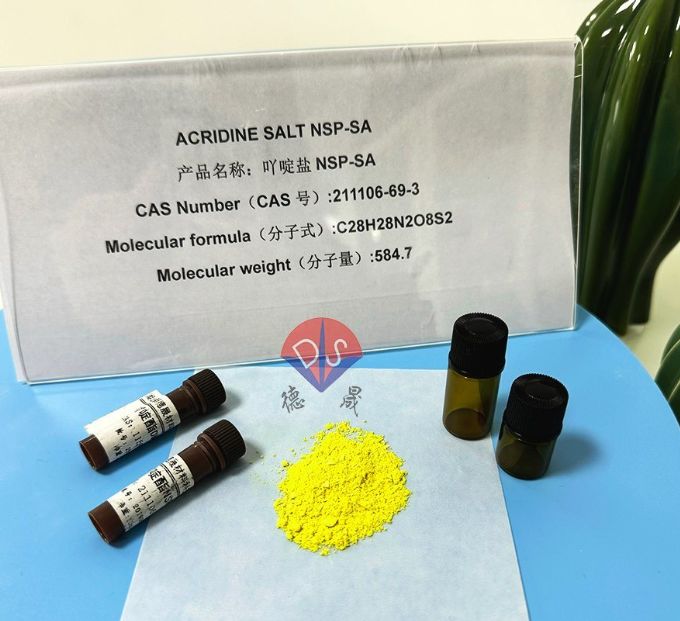
Acridine ester powder
Marker
Acridine ester: Acridine ester, as a marker, can react with biomolecules containing amino groups (such as proteins, peptides, antibodies, etc.) to form stable amide bonds. Acridine esters are just a general term, usually including various types of products such as NSP-SA-NHS, NSP-SA, ME-DMAE-NHS, etc.
Reaction components
Proteins/peptides/antibodies: These biomolecules need to contain free amino groups in order to undergo coupling reactions with acridine esters.
Buffer solution: used to maintain the pH value of the reaction, usually an alkaline buffer solution is used.
Acridine ester solution: usually prepared at a certain concentration, such as 25 mM acridine ester solution.
Reaction process
Prepare reaction mixture: Mix the acridine ester solution with the biomolecules to be labeled in a certain proportion, and add buffer solution.
Reaction: Conduct the reaction at the set pH and temperature.
Termination reaction: After reaching the predetermined reaction time, the reaction can be terminated by adding a terminating agent or changing the pH value.
Purification: remove unreacted acridine ester and other by-products by dialysis, gel filtration or desalination column.
Verification: Confirm the success of labeling by detecting the luminescence intensity or other physicochemical properties of the labeled product.
Matters needing attention
Safety: Acridine esters may have an impact on the skin, eyes, and mucous membranes. When using, it is necessary to wear protective gloves and goggles, and ensure sufficient ventilation in the laboratory.
Storage conditions: Acridine esters should avoid contact with acids, oxidants, and combustibles, and be stored under appropriate conditions.
Luminous conditions
Excitation: In the presence of alkaline hydrogen peroxide, acridine labeled proteins can emit light without enzymatic catalysis.
Detection: By adding an excitation reagent (such as hydrogen peroxide solution), the system immediately releases photons of about 430nm, which can be detected by a standard photometer (such as a luminometer).

Product packaging
In summary, the acridine ester labeling reaction is usually carried out in an alkaline environment. After the reaction is complete, unbound acridine esters need to be removed and purified, and the luminescence phenomenon can be observed by excitation under specific conditions. The acridine ester labeling reaction is a delicate process that requires strict control of various conditions to ensure successful labeling.
As a professional manufacturer of chemiluminescence reagents, Desheng Biochemical provides a range of acridine ester products, including NSP-SA-NHS, NSP-SA, ME-DMAE-NHS, etc. These products are widely praised for their excellent performance and stability. With professional knowledge and technical support in this field, Desheng Biochemical has become a partner of many research institutions and enterprises. Whether you are in the field of scientific research or in the development process of diagnostic kits, Desheng can provide you with reliable support.
Contact details
Contact number
Address: C8, Guanggu United Science and Technology City, Ezhou City, Hubei Province
Fax:0711-3704 589
Follow us
