


Ionic strength of Tris hcl buffer
Release time:
2024-10-01
Buffer solutions play an important role in biochemistry, molecular biology, and various laboratory studies. They maintain the stability of the pH value of the solution and protect biomolecules such as DNA, RNA, and proteins from damage caused by acid-base changes. Tris HCl (trihydroxymethylaminomethane hydrochloride), as a commonly used buffering agent, has been widely used in scientific research and industrial production due to its excellent buffering capacity, biocompatibility, and wide pH adjustment range. Below, Desheng will talk to you about the concept of ion strength of Tris HCl buffer and its impact on buffering performance.
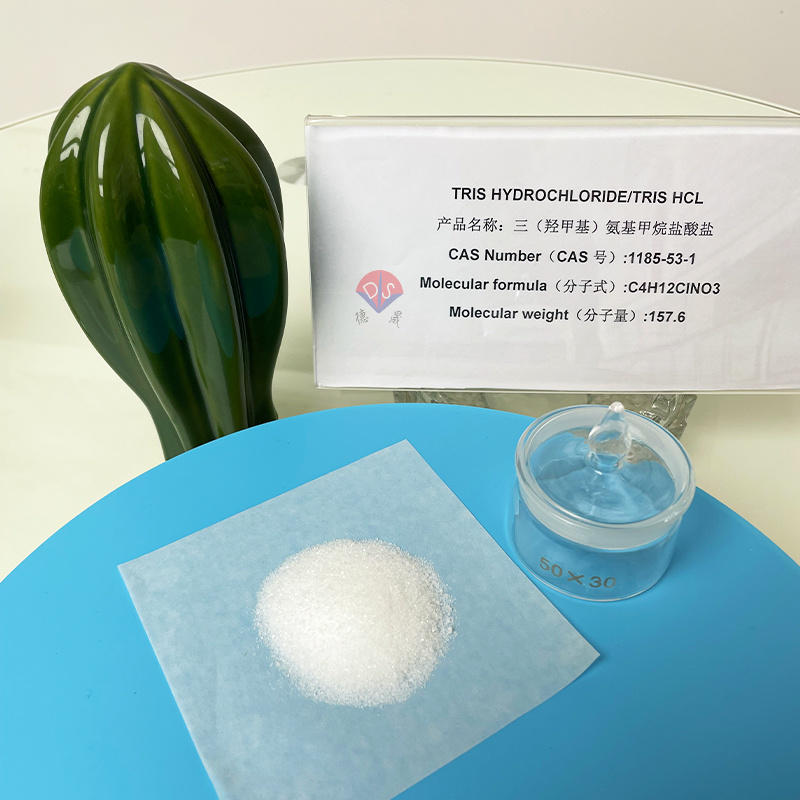
Tris HCl powder
Buffer solutions play an important role in biochemistry, molecular biology, and various laboratory studies. They maintain the stability of the pH value of the solution and protect biomolecules such as DNA, RNA, and proteins from damage caused by acid-base changes. Tris HCl (trihydroxymethylaminomethane hydrochloride), as a commonly used buffering agent, has been widely used in scientific research and industrial production due to its excellent buffering capacity, biocompatibility, and wide pH adjustment range. Below, Desheng will talk to you about the concept of ion strength of Tris HCl buffer and its impact on buffering performance.
Basic concepts of ionic strength
Ionic strength (I) is a physical quantity that measures the influence of ion concentration in a solution on its properties. It combines the concentration of all ions in the solution and the square of their charge. For Tris HCl buffer, the main ions include Tris+(trihydroxymethylaminomethane cation), H+, and Cl -. Although the concentration of H+may vary during the buffering process, overall, the contribution of Tris+and Cl - concentrations to ion strength is more significant.
The Influence of Ionic Strength of Tris HCl Buffer on Buffer Performance
1. PH stability: Ionic strength is one of the important factors affecting the pH stability of buffer solutions. A higher ionic strength can reduce the dissociation degree of weak electrolytes (such as Tris) in the solution, thereby enhancing buffering capacity and maintaining pH stability over a wider range. This is particularly important for experiments that require accurate control of pH environment.
2. Solute interaction: Ionic strength may also affect the interactions between solute molecules in a solution. At higher ionic strengths, the solvent shell around solute molecules is compressed, increasing the electrostatic interactions between solutes and potentially altering the conformation and stability of biomolecules such as proteins. Therefore, in biological experiments, selecting the appropriate ion strength is crucial for protecting biological activity.
3. Solubility and precipitation: Ionic strength can also affect the solubility of solutes. For certain salts or complexes, increasing ionic strength may reduce their solubility, leading to precipitation formation. This requires special attention during the preparation and purification process to avoid loss of target molecules.
Method for adjusting the ion strength of Tris HCl buffer
1. Adjusting salt concentration: A more direct method is to adjust the ion strength by changing the salt concentration in Tris HCl buffer. Increasing the concentrations of Tris and HCl while keeping the pH constant can directly enhance the ionic strength of the solution. However, it should be noted that excessive salt concentration may have adverse effects on biomolecules.
2. Using buffer ratio: By adjusting the ratio of Tris and HCl, it is possible to indirectly affect ion strength while maintaining the desired pH value. However, this method has relatively limited adjustment of ion strength and requires careful operation to avoid pH shift.
The importance of Tris HCl buffer in practical applications
1. Molecular biology experiments: In molecular biology experiments such as DNA electrophoresis, PCR reactions, and restriction enzyme digestion, Tris HCl buffer provides a stable pH environment, ensuring the normal functioning of enzyme activity and the stability of DNA structure. Properly adjusting the ion strength can optimize experimental conditions.
2. Protein research: Tris HCl buffer also plays an important role in protein purification, crystallization, electrophoresis, and other processes. By accurately controlling the ion strength, the interaction between proteins and other molecules can be regulated.
3. Cell culture: In cell culture, Tris HCl buffer containing appropriate ionic strength can simulate the in vivo environment and maintain normal physiological functions of cells. In addition, by adjusting the ion strength, the response mechanism of cells to changes in osmotic pressure can also be studied.

Product packaging
The ionic strength of Tris HCl buffer is an important parameter for its performance, which significantly affects the pH stability, solubility, and precipitation of the solution. By adjusting the ion strength reasonably, experimental conditions can be optimized and the accuracy of experimental results can be improved. As a manufacturer of Tris HCl buffer, Desheng can supply analytical grade raw material powders, which are easy to prepare and use, have low ionic strength, and can be applied to the vast majority of experiments at a cheap price. If you have any relevant intentions, please feel free to click on the website to inquire about details and purchase at any time!
Contact details
Contact number
Address: C8, Guanggu United Science and Technology City, Ezhou City, Hubei Province
Fax:0711-3704 589
Follow us
