


The strength and stability of MOPS protein structure still depend on it
Release time:
2024-09-22
MOPS (3-methylpropanesulfonic acid) is a zwitterionic biological buffer commonly used in biochemical research to stabilize protein structures, including interactions with bovine serum albumin (BSA). The mechanism by which MOPS buffer interacts with the peptide skeleton of bovine serum albumin to stabilize protein structure can be mainly understood from the following aspects.
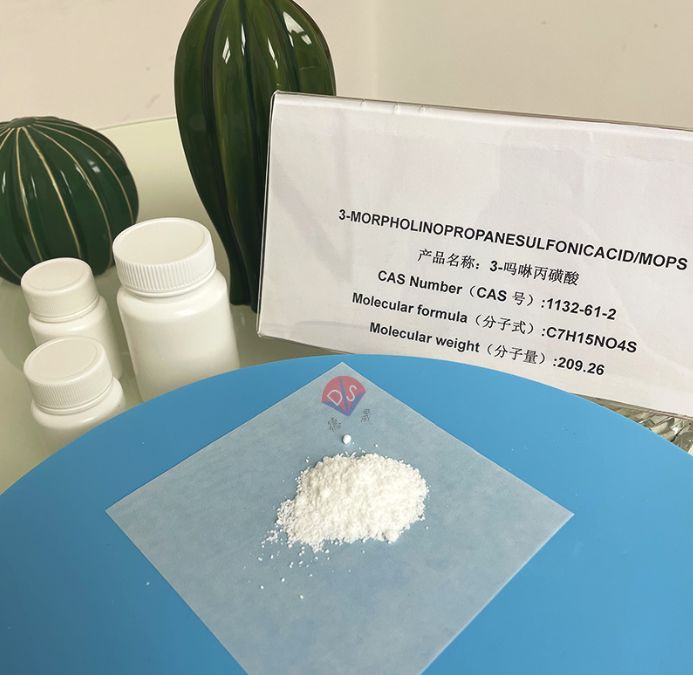
MOPS powder
1. Charge interaction
MOPS, as a zwitterionic compound, has a specific pKa value (7.2) and can maintain its charge balance within the physiological pH range (such as 6.5-7.9). This charge balance enables MOPS to undergo electrostatic interactions with negatively charged protein surfaces, such as the peptide backbone of BSA, thereby helping to stabilize the protein structure.
2. Hydration layer protection
The hydrophilic groups (such as sulfonic acid groups) in MOPS molecules can form strong hydration with water molecules, thereby forming a stable hydration layer on the protein surface. This hydration layer can reduce direct contact between proteins and solvents or other molecules, prevent protein aggregation or denaturation, and thus protect the structural stability of proteins.
3. Spatial steric hindrance effect
The size and shape of MOPS molecules can generate a certain steric hindrance effect around proteins. This spatial hindrance can prevent other molecules or ions from approaching the key binding sites or active centers of proteins, thereby protecting the protein's function from interference.
4. Interaction with specific amino acid residues
BSA is a complex protein composed of multiple amino acid residues, and its peptide backbone contains various types of amino acid residues. MOPS may enhance the stability of protein structure by interacting with specific amino acid residues in BSA, such as negatively charged amino acid residues, through hydrogen bonding, ionic bonding, and other interactions.
5. Buffer effect
MOPS, as a buffer solution, can stabilize the pH value of a solution within a certain range. In biochemical reactions, changes in pH often have a significant impact on the structure and function of proteins. Therefore, the buffering effect of MOPS helps to maintain the pH stability of the environment in which the protein is located, thereby protecting the structure of the protein from damage.
6. Experimental evidence
Studies have shown that MOPS can interact with the peptide backbone of BSA and significantly prevent thermal denaturation of BSA under heating and other conditions (refer to Article 1). This indicates that MOPS has important application value in stabilizing protein structures.

Product packaging
In summary, MOPS stabilizes protein structure through various mechanisms such as charge interaction with the peptide skeleton of bovine serum albumin, formation of hydration layer protection, steric hindrance effect, interaction with specific amino acid residues, and buffering effect. These mechanisms work together to make MOPS an important protein stabilizer in biological and biochemical research.
As a professional R&D and production manufacturer in the field of biological buffering agents, Desheng not only provides highly recognized MOPS buffering agents, but also covers dozens of widely used biological buffering agents such as TRIS, HEPES, CAPS, TAPS, BICINE, etc. in the market. Desheng attaches great importance to cooperation and communication with scientific research institutions, constantly understands the needs and challenges of cutting-edge scientific research, continuously optimizes product performance, and will launch more products that meet market demand.
Contact details
Contact number
Address: C8, Guanggu United Science and Technology City, Ezhou City, Hubei Province
Fax:0711-3704 589
Follow us
