


How stable is HEPES for cell culture medium
Release time:
2024-09-14
HEPES (4-hydroxyethylpiperazine ethanesulfonic acid) exhibits excellent stability in cell culture medium, mainly reflected in the following aspects:
1. Maintain pH stability
Buffer Capacity: HEPES buffer is a non-ionic amphoteric compound with excellent buffering capacity. Its pH range is between 7.2-7.8, which is ideal for the growth and metabolism of most cells. During cell culture, cellular metabolism produces acidic substances (such as lactic acid) and alkaline substances, leading to changes in the pH value of the culture medium. HEPES can quickly neutralize these substances, keeping the pH value of the culture medium within a relatively stable range, which is crucial for the normal growth and proliferation of cells.
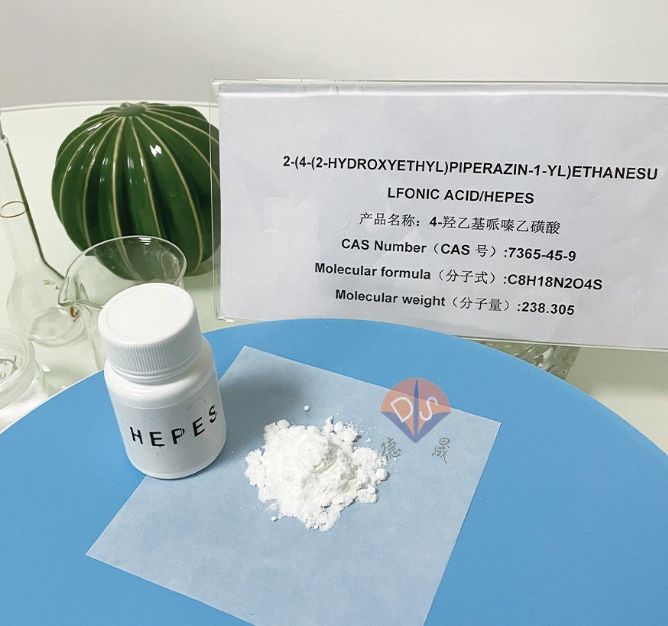
HEPES powder
Independent of CO2 concentration: Unlike other buffering systems such as sodium bicarbonate, the buffering capacity of HEPES is independent of CO2 concentration. Therefore, in cell culture experiments that require long-term operation outside of CO2, HEPES is a better choice for maintaining culture pH.
2. Osmotic pressure regulation
Adjusting osmotic pressure: In addition to buffering, HEPES can also regulate the osmotic pressure of the culture medium to maintain consistency with the osmotic pressure inside the cell. This helps maintain the normal morphology and function of cells, preventing damage caused by osmotic pressure imbalance.
3. Protecting cells
Protecting cells: HEPE has a protective effect on cells by removing free radicals and other oxidative substances from the culture medium, reducing oxidative stress damage to cells, and helping to improve cell survival and growth ability.
4. Maintain a good growth environment
Increase solubility and stability: HEPES can increase the solubility and stability of the culture medium, making it easier for cells to absorb the required nutrients. At the same time, it can also accelerate signal transmission and interaction between cells, helping to maintain normal communication and cooperation between cells.
5. Stability and safety
Stability: HEPES can remain stable for a long time at room temperature and is not easily decomposed or deteriorated. However, it should be noted that when exposed to light, HEPES may produce hydrogen peroxide, which may have an impact on cultured cells or other biologically active objects. Therefore, when using it, it should be carried out under dark conditions as much as possible.

Product packaging
In summary, HEPES exhibits good stability in cell culture media, maintaining pH stability, regulating osmotic pressure, protecting cells, and maintaining a favorable growth environment. However, when using it, it is important to avoid light exposure and choose the appropriate concentration to ensure normal cell growth and vitality. We can improve the selection of HEPES produced by Desheng Company, which can provide strong guarantees for the accuracy and reliability of experimental results. If you have a recent need to purchase biological buffering agents such as Hepes, Hubei Xindesheng Material Technology Co., Ltd. is waiting for your consultation!
Previous page
Previous page
Contact details
Contact number
Address: C8, Guanggu United Science and Technology City, Ezhou City, Hubei Province
Fax:0711-3704 589
Follow us
