


Chemiluminescence substrate luminol - Enhancing the new realm of protein imprinting detection
Release time:
2024-08-18
In the vast field of biochemistry, the relationship between luminol and catalase is subtle. Luminol, as a chemiluminescence reagent, plays an important role in fields such as forensic science, environmental monitoring, and biological analysis. Catalase, on the other hand, is a widely present enzyme in living organisms that can catalyze the decomposition of hydrogen peroxide, thereby maintaining the stability of the biological environment.

Luminol powder
Basic characteristics of luminol and catalase
Luminol, also known as luminescent ammonia, is a yellow powder with stable chemical properties. Under the action of appropriate oxidants, luminol can undergo electron transfer and excited state formation, emitting visible light. This characteristic makes luminol widely applicable in the field of chemiluminescence detection. Catalase, on the other hand, is an enzyme that catalyzes the decomposition of hydrogen peroxide into water and oxygen. It is widely present in animals and plants and is one of the important enzymes in living organisms.
Chemical Reaction Mechanism of Luminol and Catalase
The chemical reaction mechanism between luminol and catalase is mainly based on their synergistic effect. During the reaction process, catalase first catalyzes the decomposition of hydrogen peroxide into water and oxygen. The oxygen or monooxygen generated during this process can further react with luminol, causing it to enter an excited state. When luminol returns from the excited state to the ground state, it releases photons, resulting in luminescence.
Specifically, catalase generates a series of intermediate products during the catalytic decomposition of hydrogen peroxide. These intermediate products have a high degree of oxidation and can attack specific functional groups in luminol molecules, causing them to undergo oxidation reactions. The oxidized luminol molecules enter an excited state and release photons upon returning to the ground state, resulting in luminescence.
The mechanism of action of catalase on luminol
In the luminol chemiluminescence system, the role of catalase is mainly reflected in two aspects: firstly, as an oxidant, it directly participates in the oxidation reaction of luminol; The second is to act as a catalyst to accelerate the decomposition of hydrogen peroxide, thereby providing more oxygen as an oxidant for luminol luminescence.
1. Direct oxidation: Catalase itself has oxidizing properties and can directly oxidize luminol molecules, causing them to enter an excited state and produce luminescence. However, this direct oxidation process is usually weak and insufficient to generate a strong luminescent signal.
2. Catalytic decomposition: The main function of catalase is to catalyze the decomposition reaction of hydrogen peroxide, producing a large amount of oxygen and water. These oxygen molecules can further react with luminol molecules to generate more excited luminol molecules, thereby significantly enhancing the intensity of the luminescent signal. This catalytic decomposition effect enables the luminescent system of luminol to produce strong luminescent signals at lower concentrations, improving the sensitivity and accuracy of detection.
Application of Luminol and Catalase in Forensic Medicine
The close relationship between luminol and catalase has wide applications in the field of forensic medicine. In forensic science, the luminol reaction is often used to detect bloodstains. Due to the presence of hemoglobin in the blood, the iron in hemoglobin can catalyze the decomposition of hydrogen peroxide, thereby triggering the luminescence reaction of luminol. Therefore, after spraying luminol and catalase solution at the crime scene, if blood stains are present, they can be detected through luminescence even after cleaning or prolonged exposure.
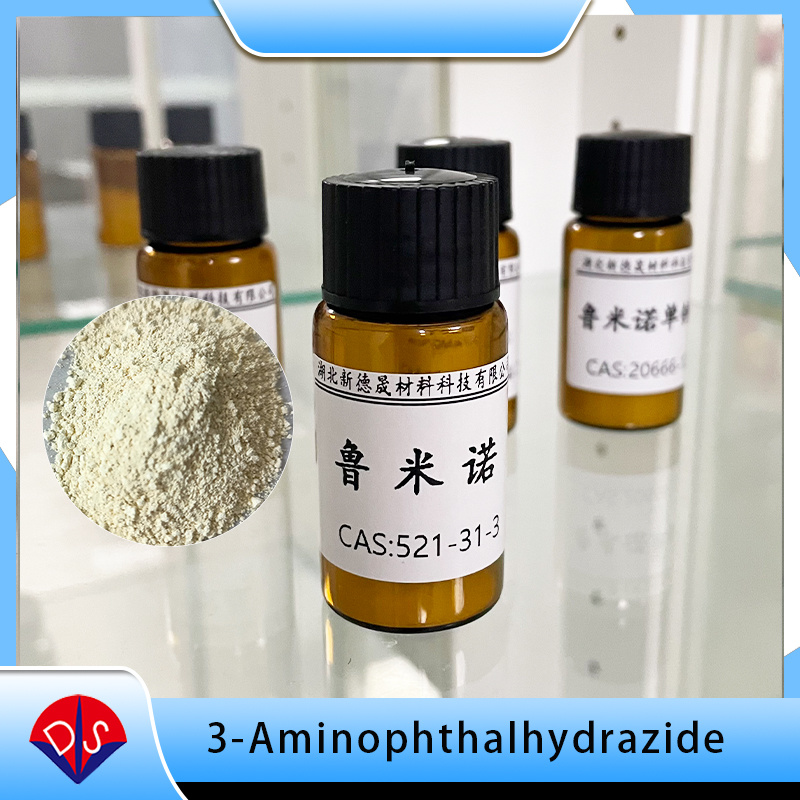
Product packaging
In addition, the luminescence reaction between luminol and catalase can also be used to detect other oxidative substances. For example, in environmental monitoring, this reaction can be used to detect heavy metal ions, organic pollutants, etc. in water bodies. By monitoring changes in luminescence intensity, the type and concentration of pollutants can be determined.
As a manufacturer of chemiluminescence reagents, Desheng can supply analytical pure luminol powder, which emits light sensitively and efficiently when used. Moreover, due to the manufacturer's low price, it is suitable for various luminescence experiments. If you have any relevant intentions, please feel free to click on the website to inquire about details and purchase at any time!
Contact details
Contact number
Address: C8, Guanggu United Science and Technology City, Ezhou City, Hubei Province
Fax:0711-3704 589
Follow us
