


The multifunctional application of CAPS buffer
Release time:
2024-06-20
In the field of life science research, biological buffering agents play a crucial role. They not only provide a stable environment for experiments, but also serve as the cornerstone to ensure the accuracy and reliability of experimental results. Among numerous biological buffering agents, CAPS buffer (CAS 1135-40-6) plays an indispensable role in biological and biochemical research due to its unique zwitterionic properties.

CAPS buffer
Amphoteric ion buffer
CAPS, The full name is 3- (cyclohexylamino) -1-propanesulfonic acid, which is a zwitterionic biological buffer. Its uniqueness lies in its ability to act as both a cation in acidic environments and as an anion in alkaline environments. This characteristic enables CAPS to maintain stable buffering capacity across a wide pH range, providing an ideal experimental environment for biological and biochemical experiments.
Cation exchange HPLC
In biotechnology, cation exchange chromatography is a commonly used separation technique. CAPS, as an ideal buffer for cation exchange chromatography, can help researchers separate target proteins from complex mixtures, laying a solid foundation for subsequent research work.
capillary electrophoresis
Capillary electrophoresis is a convenient and fast protein separation technique. CAPS buffer, as an electrophoretic buffer, can optimize electrophoresis conditions, improve protein separation efficiency, and enable researchers to analyze protein composition and properties more accurately.
Protein separation system
CAPS is widely used as a separator in protein separation systems. Whether through gel filtration, ion exchange or affinity chromatography, CAPS can provide a stable buffer environment for proteins to ensure that proteins will not lose their activity or denature during the separation process.
Diffusion imprinting and electrophoresis imprinting
In the field of molecular biology, diffusion blotting and electrophoresis blotting are commonly used protein detection techniques. CAPS, as a buffer for these technologies, can ensure the stability of proteins during the imprinting process, improve the accuracy and sensitivity of detection.
Research on Enzymatic Processes
Under physiological conditions, the activity of many enzymes is influenced by pH value. As a biological buffer, CAPS can stabilize enzyme activity above physiological pH values, providing researchers with a broader experimental space. This enables researchers to explore the structure and function of enzymes more deeply, providing important references for the development and design of new drugs.
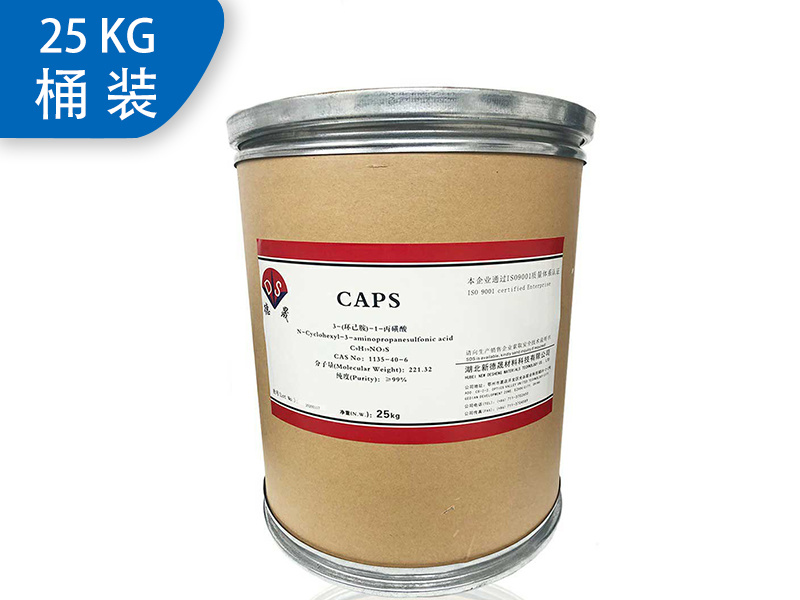
Product packaging
The biological buffering agents such as CAPS produced by Desheng play an important role in biological and biochemical research. Its broad application prospects make CAPS an indispensable assistant for researchers. In the future, with the continuous development of biotechnology, the application fields of CAPS will be more extensive, injecting more vitality into the research of life sciences.
Contact details
Contact number
Address: C8, Guanggu United Science and Technology City, Ezhou City, Hubei Province
Fax:0711-3704 589
Follow us
