


MOPS empowers low-temperature dyeing of polylactic acid fibers: unlocking a new path for environmentally friendly textile buffering
Release time:
2026-03-14
In the context of advocating sustainable development today, traditional high-temperature and high-pressure dyeing processes are facing severe challenges due to high energy consumption, high water consumption, and damage to fiber structures. Especially for thermosensitive biobased materials such as polylactic acid (PLA) fibers, their glass transition temperature is low, making it difficult to withstand the conditions required for conventional polyester dyeing. To this end, researchers have developed a low-temperature dyeing technology based on enzyme catalyzed surface modification, which significantly reduces energy consumption while enhancing dye affinity. In this innovative process, MOPS buffer serves as a key reaction medium, providing essential chemical support for maintaining enzyme activity and staining uniformity.

MOPS powder
Enzyme catalyzed modification: the core breakthrough of low-temperature staining
Although polylactic acid fibers have environmental advantages such as renewability and degradability, their molecular chains lack polar groups, resulting in strong hydrophobicity and poor dyeing performance. The new low-temperature staining method takes a different approach: first, specific enzymes (such as lipase or esterase) are used to selectively hydrolyze the surface of PLA fibers under mild conditions, generating hydrophilic groups such as carboxyl and hydroxyl groups; Subsequently, dye adsorption and fixation are completed at lower temperatures. This process is highly dependent on the pH stability of the reaction system. The catalytic efficiency of enzymes can only be maximized within their optimal pH window, while hydrolysis reactions themselves release organic acids. Without effective buffering, the pH of the system will rapidly decrease, leading to enzyme inactivation, uneven modification, and ultimately resulting in color difference or insufficient color fastness.
MOPS: Building a Stable and Efficient Microenvironment for Enzymatic Reactions
In this process, MOPS or Tris HCl can be used as the buffer system. The sulfonic acid group of MOPS endows it with good water solubility and ionic strength stability, and can maintain buffering efficiency even in dye baths containing electrolytes. Experiments have shown that the surface hydrophilicity of PLA fibers treated with enzymes in MOPS buffer system is significantly improved, the dye uptake rate is increased by more than 15%, and the color light is uniform and the batch repeatability is good. In addition, MOPS has no absorption in the visible light range and does not interfere with online monitoring or color difference evaluation during the dyeing process, making it suitable for intelligent dyeing and finishing control systems.
Promoting green printing and dyeing: a key link from laboratory to industrialization
With the advancement of the "dual carbon" goal, dyeing and finishing technologies with low temperature, low water, and low chemical consumption have become the direction of industry transformation. Although MOPS is not directly involved in dyeing, it acts as a "regulator behind the scenes" to ensure the feasibility and stability of the green process of enzymatic modification. MOPS, with its stable pH regulation ability and excellent chemical compatibility, has become a key bridge for ligase catalysis and efficient staining.
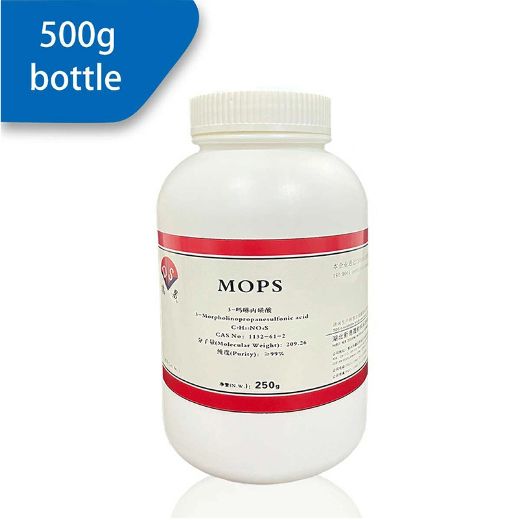
Product packaging
In the green revolution of low-temperature dyeing of polylactic acid fibers, choosing high-purity and stable MOPS is not only a guarantee of process efficiency, but also a commitment to the sustainable textile future. Hubei Xindesheng Material Technology Co., Ltd., as a professional manufacturer of biological buffering agents, will continue to provide high-quality products and professional technical services to help the textile industry move towards a new stage of low-carbon, intelligent, and high-quality. Welcome to inquire about cooperation and jointly paint a new picture of green printing and dyeing.
Contact details
Contact number
Address: C8, Guanggu United Science and Technology City, Ezhou City, Hubei Province
Fax:0711-3704 589
Follow us
