


The key role of trihydroxymethylaminomethane in high-temperature and corrosion-resistant coatings
Release time:
2026-03-12
Aluminum alloy heat exchange tubes are widely used in industrial fields such as energy, chemical, and HVAC (Heating, Ventilation, and Air Conditioning) due to their advantages of lightweight, high thermal conductivity, and easy processing. However, it is prone to pitting corrosion, intergranular corrosion, and even stress cracking in environments with high temperature, high humidity, or corrosive media such as chloride ions and sulfides, which seriously restricts the service life and operational safety of the equipment. To overcome this bottleneck, a composite coating technology based on modified hexagonal boron nitride (h-BN) has emerged. In the core preparation process of the coating - surface functionalization of hexagonal boron nitride, Tris buffer played an irreplaceable role as a pH regulator and builder of the reaction microenvironment.
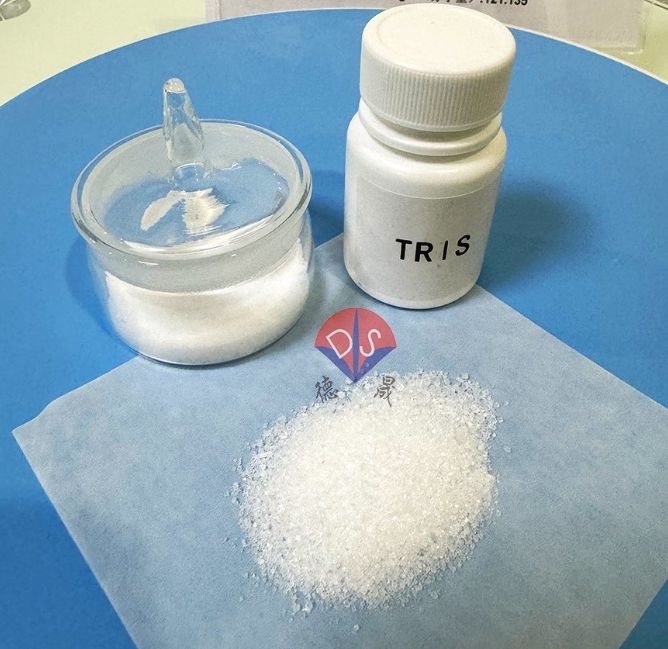
Tris buffer
The challenge of surface modification: how to activate inert h-BN?
Hexagonal boron nitride is considered an ideal functional filler due to its graphite like layered structure, high thermal conductivity, chemical inertness, and excellent thermal stability. However, its surface lacks active functional groups, making it difficult to form an effective interface with the organic resin matrix, resulting in easy delamination and decreased mechanical properties of the coating. To this end, researchers have adopted a dopamine biomimetic modification strategy: by in-situ polymerization of polydopamine (PDA) on the surface of h-BN, abundant phenolic hydroxyl and quinone groups are introduced to enhance its dispersibility and interfacial compatibility.
However, the self polymerization reaction of dopamine is highly sensitive to pH - it can only proceed efficiently under weakly alkaline conditions (pH ≈ 8.5). If the pH is too low, dopamine is difficult to oxidize; If it is too high, it is easy to form uneven precipitation. Therefore, it is crucial to choose a buffering system with strong buffering capacity, high chemical inertness, and no interference with subsequent reactions.
Trihydroxymethyl aminomethane: Creating an Ideal Microenvironment for Dopamine Aggregation
In this process, Tris is dissolved in deionized water and used to adjust and stabilize the pH of the system at 8.5. Tris has a pKa of approximately 8.06 (25 ℃) and has a strong buffering capacity near this pH, which can effectively counteract the proton fluctuations generated during dopamine oxidation and ensure the smooth progress of the reaction. More importantly, Tris molecules themselves do not contain strong coordinating groups, do not undergo side reactions with dopamine or h-BN, and do not introduce metal ion impurities, thus ensuring the purity and performance consistency of the modified product.
Experiments have shown that in the Tris buffer system, dopamine hydrochloride and hexagonal boron nitride powder can be uniformly coated on the surface of h-BN layers after ultrasonic dispersion and reaction at 60 ℃ for 24-25 hours. The dispersion stability of the modified h-BN obtained is significantly improved in organic solvents and resin matrices, with no obvious agglomeration phenomenon. After adding it to the composite coating slurry, not only did it enhance the density of the coating, but it also synergistically improved its heat resistance and resistance to Cl ⁻ penetration.

Product packaging
From laboratory to industrial applications: high-purity Tris is a prerequisite for quality assurance
Hubei Xindesheng Material Technology Co., Ltd., as a manufacturer of biological buffering agents, has long focused on the research and production of Tris (Tris). The company's products can be widely used in other fields such as high-temperature and corrosion-resistant coatings. Of particular note is that the company's Huanggang production base will officially start production in March April 2026, significantly increasing Tris production capacity to meet the diverse needs of new material enterprises from gram level research and development to ton level mass production.
Contact details
Contact number
Address: C8, Guanggu United Science and Technology City, Ezhou City, Hubei Province
Fax:0711-3704 589
Follow us
