


Analysis of the key role of NHS groups in acridine ester labeling
Release time:
2026-01-21
In chemiluminescence immunoassay technology, acridine ester compounds are widely used for labeling biological molecules such as proteins, antibodies, and nucleic acids due to their high luminescence efficiency and stable chemical properties. In these labeling systems, a seemingly unrelated chemical structure - the NHS group - actually plays an irreplaceable role in achieving labeling. Although it does not participate in the final luminescent reaction, its presence gives acridine ester the ability to covalently bind with the target molecule.
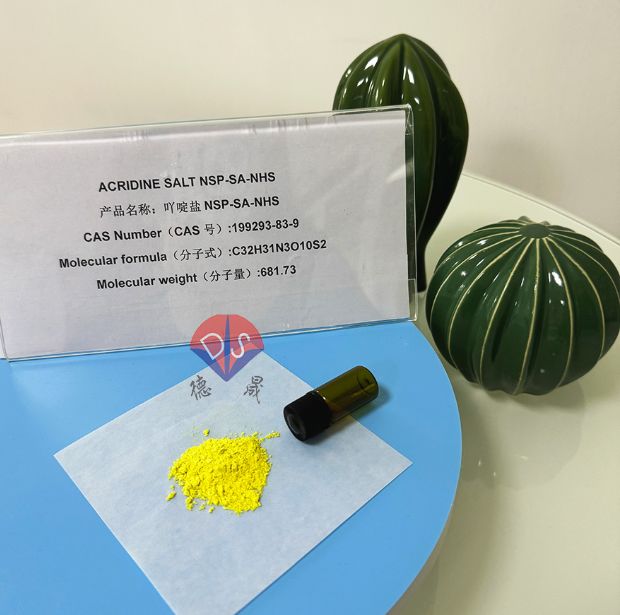
acridine ester powder
The basic function of NHS groups: to achieve covalent bonding of biomolecules
In many acridine ester or acridine sulfonamide structures, NHS (N-hydroxysuccinimide) active groups are often introduced. The main function of this group is to act as a cross-linking bridge, allowing acridine esters to react with biomolecules containing primary amines (- NH ₂). This type of molecule includes antibodies, enzymes, peptides, and various proteins, whose N-terminal or lysine residue side chains generally contain free primary amines. Through specific reactions between NHS esters and these primary amines, acridine esters can be stably linked to target proteins, forming markers that can be used for subsequent detection.
Chemical Structure and Reaction Mechanism of NHS Esters
NHS ester is an active ester structure formed by the condensation reaction between the hydroxyl group in N-hydroxysuccinimide and the carboxyl group in acridine ester molecules (- COO-N -). Under appropriate reaction conditions, the carbonyl carbon in this structure exhibits strong electrophilicity and is susceptible to nucleophilic attacks from primary amines on proteins. During the reaction process, the C-O bond is broken, releasing NHS byproducts and forming a stable amide bond (- CONH -) between the acridine ester and the protein. This structure is similar to natural peptide bonds and has good chemical stability, ensuring that the labeled complex is not easily dissociated in subsequent detection.
Why are NHS esters widely used?
Although there are various chemical groups that can react with amino groups, such as isothiocyanates and carbodiimides, NHS esters have become the mainstream choice due to their mild reaction conditions, high efficiency, and wide applicability. Most proteins contain multiple lysine residues or exposed N-terminal amino groups. Under physiological pH conditions, these primary amines are usually positively charged and located on the protein surface, making them easy to come into contact with water-soluble reagents and react with them. Meanwhile, primary amines exhibit strong nucleophilicity in biomolecules, enabling them to efficiently couple with NHS esters and achieve high labeling rates. In addition, the reaction of NHS esters does not require additional catalysts, is easy to operate, and is suitable for use in conventional buffer systems. Therefore, it is widely used in the construction of fluorescent probes, biotin labeling, and other molecular probes.
Precautions during use
In practical applications, attention should be paid to the hydrolysis of NHS esters. The active ester will undergo hydrolysis in aqueous solution, generating a non reactive carboxylic acid form, thereby reducing the labeling efficiency. The hydrolysis rate increases with increasing pH, so it is recommended to perform labeling reactions in physiological to weakly alkaline environments with pH 7.2-9 to balance reaction activity and hydrolysis rate. Common buffer systems include phosphate, carbonate, HEPES, or borate buffer solutions. It is worth noting that Tris and other buffer solutions containing primary amines can compete with the target protein for reaction, interfere with the labeling process, and should be avoided. After the reaction is completed, the unreacted active sites can be blocked by adding excess Tris or glycine to terminate the reaction in a timely manner.
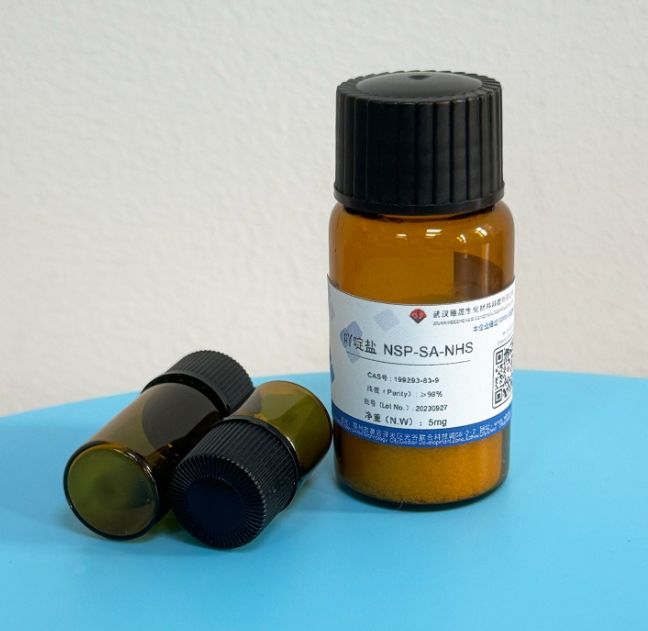
Product packaging
For the development of chemiluminescence reagents, the purity and stability of NHS esters directly affect the final labeling effect and detection performance. Hubei Xindesheng focuses on the research and production of chemiluminescence series products, providing various types of acridine ester products, as well as supporting the supply of applicable buffer systems and technical guidance. If you are looking for reliable acridine ester products, please contact Hubei Xindesheng for detailed information and sample support.
Contact details
Contact number
Address: C8, Guanggu United Science and Technology City, Ezhou City, Hubei Province
Fax:0711-3704 589
Follow us
