


Is the sensitivity of chemiluminescence reagent luminol not good? Maybe it's due to your improper operation
Release time:
2025-09-15
Luminol, as a classic chemiluminescence reagent, plays an important role in various fields such as chemical analysis, criminal investigation, and biomedical testing due to its luminescent properties. However, in practical applications, some users may encounter the problem of insufficient luminescence sensitivity of luminol, resulting in unsatisfactory detection results. In fact, in addition to the quality factors of the reagents themselves, many details in the operation process are often the key factors affecting the sensitivity of luminol.
Potential issues in the solution preparation process
1. Improper control of reagent concentration: The concentration of luminol solution is closely related to luminescence sensitivity. Low concentration results in insufficient substances involved in the luminescent reaction, making it difficult to generate strong luminescent signals; Excessive concentration also reduces sensitivity. The correct approach is to strictly follow the experimental requirements, use a weighing instrument with appropriate accuracy, such as a one ten thousandth electronic balance, accurately weigh the luminol reagent, and prepare the solution using a gradual dilution method to ensure accurate concentration.
2. Improper solvent selection and treatment: Luminol has different solubility and stability in different solvents, and improper solvent selection can directly affect its luminescence performance. In some experimental scenarios, adding an appropriate amount of organic solvents such as dimethyl sulfoxide (DMSO) can improve the solubility of luminol, but attention should be paid to controlling its addition ratio to prevent adverse effects on the acidity and luminescence reaction of the system.
Key factors for controlling reaction conditions
1. pH adjustment error: Luminol luminescence reaction is extremely sensitive to the pH of the system. In alkaline environments, luminol molecules undergo deprotonation, generating anions with strong reactivity, which then react with oxidants to produce luminescence. In practical operation, it is necessary to use a precision pH meter to monitor the acidity and alkalinity of the reaction system in real time.
2. Inaccurate control of temperature and reaction time: Temperature has a dual impact on the luminescence reaction rate and sensitivity of luminol. The temperature is too low, the chemical reaction rate slows down, and the luminescence signal is generated slowly and weakly; The temperature is too high, the reaction is too intense, the lifetime of excited state products is shortened, resulting in short luminescence duration and decreased sensitivity. Generally speaking, at room temperature, the luminescent reaction of luminol can achieve good results. In addition, the control of reaction time cannot be ignored. If the reaction time is too short, luminol and oxidant have not fully reacted, and the luminescence signal has not reached its peak; If the reaction time is too long, the sensitivity may decrease due to the loss of substances in the system and the occurrence of side reactions. There are differences in the required reaction time for different experimental scenarios and detection objects, and it is usually necessary to explore and determine through pre experiments.
Details and omissions in the experimental operation process
1. Improper sample processing: In biomedical detection and other application scenarios, the processing method of the sample directly affects the detection effect of luminol. If the sample contains too many impurities, it will compete with luminol or oxidants, consume reactants, and reduce luminescence sensitivity.
2. Improper use and maintenance of instruments and equipment: The performance status and operating standards of instruments and equipment used in the detection process, such as luminometers and spectrophotometers, are important for the accuracy and sensitivity of detecting luminol luminescence signals. If there are problems such as pollution and aging in the optical path system of the instrument, it will lead to a decrease in the efficiency of optical signal transmission, resulting in a lower detected luminous intensity. Therefore, before each experiment, it is necessary to thoroughly inspect and calibrate the instrument to ensure that it is in good working condition.
Luminol, as a high-performance chemiluminescence reagent, often has poor sensitivity due to improper operation. From solution preparation, reaction condition control, to experimental operation process and elimination of interference factors, every detail may have a significant impact on the detection results. Only by fully understanding the luminescent properties of luminol, strictly following experimental operating procedures, carefully investigating and solving problems during the operation process, can the performance advantages of luminol be fully utilized.
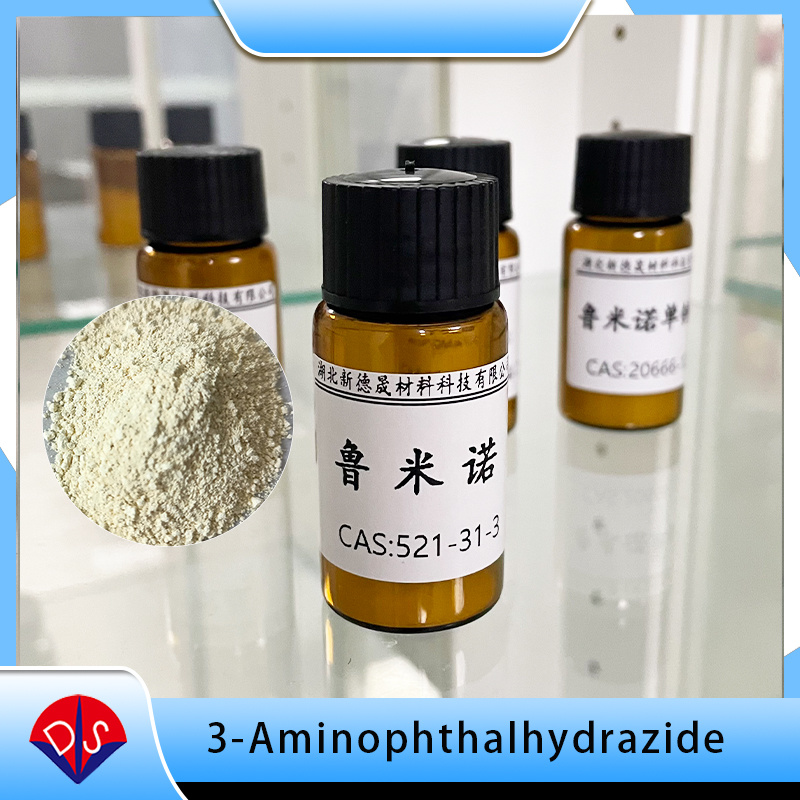
Product packaging
As a research and development manufacturer of luminol, Hubei Xindesheng has always focused on optimizing reagent performance and innovating processes. The company has established a professional R&D team to conduct in-depth research on the luminescence mechanism of luminol, and improve product purity and luminescence efficiency by optimizing the synthesis pathway. If you have any purchasing needs, please feel free to contact us at any time!
Contact details
Contact number
Address: C8, Guanggu United Science and Technology City, Ezhou City, Hubei Province
Fax:0711-3704 589
Follow us
