


Will the performance of acridine ester affect the use of chemiluminescence instruments and equipment?
Release time:
2024-10-05
The performance of acridine esters does indeed affect the use of chemiluminescence instruments and equipment, manifested in the following aspects.
luminous efficiency
The high luminescence efficiency of acridine ester means that less labeling can generate sufficient light signal, which allows the instrument to use lower concentrations of labeling for detection, potentially reducing reagent costs and improving detection sensitivity.
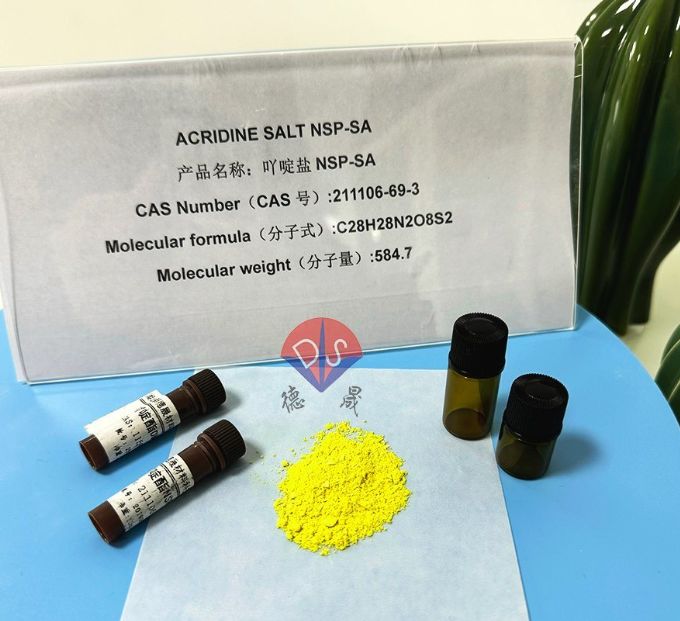
acridine esters powder
Luminescent kinetics
The luminescence kinetics of acridine esters, such as peak luminescence time and half-life, determine the time window of chemiluminescence reactions. If the luminescence response is rapid and brief, the instrument needs to respond quickly and collect data in a short period of time. This may require the instrument to have high-speed data acquisition capabilities and accurate reaction timing control.
stability
The stability of acridine ester in buffer solution affects the storage and shelf life of the label. Unstable markers may lead to signal attenuation, affecting the reliability of experimental results. The instrument may need to be designed with special storage conditions or pre-processing steps to ensure the stability of acridine esters.
Background illumination
Acridine esters with low background luminescence help improve signal-to-noise ratio, enabling instruments to detect weak signals more accurately. This means that the detection limit of the instrument can be lower, thereby improving the detection sensitivity of the entire system.
compatibility
Whether acridine esters are easily bound to proteins or other biomolecules, as well as the stability after binding, will affect the labeling efficiency and the properties of the labeling complex. This may require the instrument to have specific labeling and processes to eliminate non-specific binding.
Reaction conditions
The reaction conditions required for acridine ester luminescence, such as pH, temperature, oxidant type and concentration, will determine the design of the instrument's reaction module, including reaction vessel, temperature control, reagent addition system, etc.
Degree of automation
If the use of acridine esters requires complex operational steps, highly automated instruments will be more advantageous to reduce operational errors and improve experimental consistency.
In summary, the performance characteristics of acridine esters directly affect the hardware design, software algorithms, and operating procedures of chemiluminescence instruments, thereby affecting the overall performance and user experience of the detection system.

Product packaging
As a leading manufacturer of chemiluminescence reagents, Desheng can provide six types of acridine ester products (including those with and without NHS groups) that are stable in luminescence, easy to prepare, and convenient to store. These products not only have simple preparation, but also high luminescence efficiency and good thermal stability. Moreover, these luminescent reagents have high light quantum yield and low background, making them suitable for most luminescence experiments. We are offering a low price discount promotion. Orders placed on the same day can be shipped on the same day. If you are interested, please click on the website to inquire about details and make a purchase!
Contact details
Contact number
Address: C8, Guanggu United Science and Technology City, Ezhou City, Hubei Province
Fax:0711-3704 589
Follow us
