


Failed to prepare BES buffer raw materials? Follow these steps
Release time:
2024-09-06
In the field of chemical synthesis, the preparation of buffer BES buffer (N, N-bis (2-hydroxyethyl) -2-aminoethanesulfonic acid) is a critical and delicate process. As an important reagent in biochemical experiments, even if the standard synthesis route is followed during the preparation process, there may be situations where the raw material preparation fails. Starting from the key links of the BES synthesis route, we will analyze the possible reasons for preparation failure and provide corresponding solutions to help experimenters identify problems and optimize the preparation process.
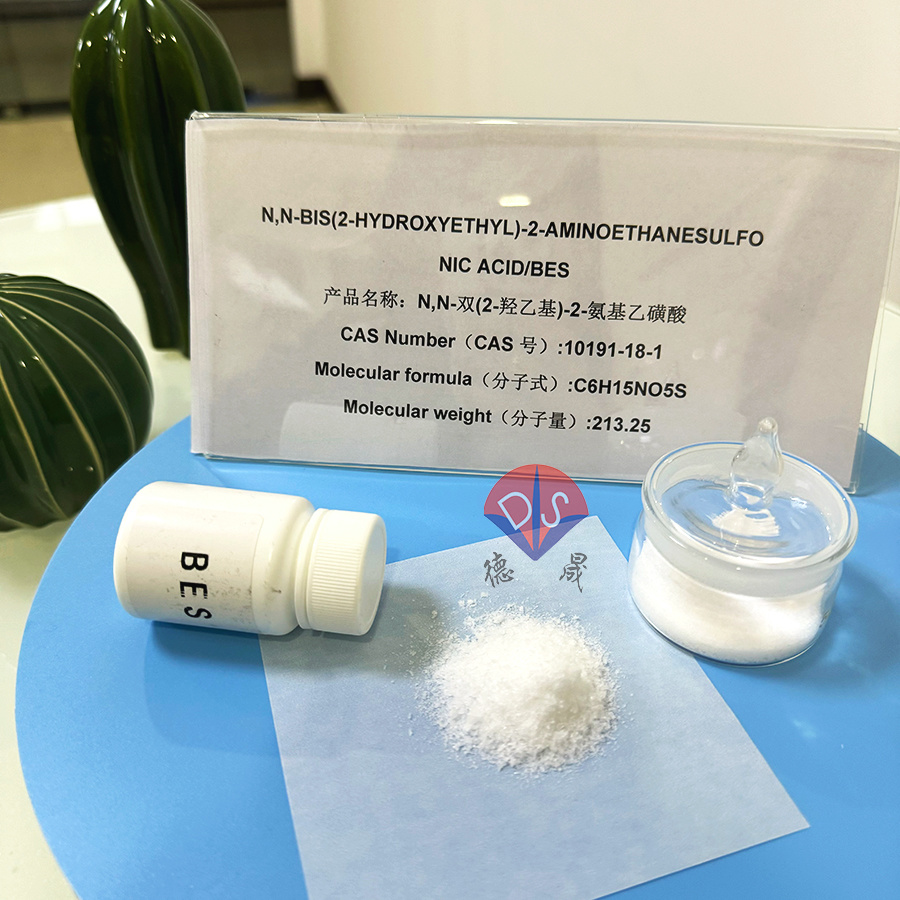
BES powder
Selection and Preparation of BES Raw Materials
1. Purity and Quality of BES Preparation Raw Materials
First, it is necessary to confirm that all raw materials, such as diethanolamine, sodium 2-chloroethanesulfonate, and sodium hydroxide, are analytical grade reagents and have not expired. The purity of the raw material directly affects the reaction efficiency and the purity of the product. If the raw material contains impurities, it may lead to a decrease in reaction rate, an increase in by-products, or difficulty in separating and purifying the target product.
2. Measurement and proportioning of raw materials for BES preparation
Strictly follow the stoichiometric ratio in the chemical equation (especially the 1:1.1 ratio of diethanolamine to sodium chloroethanesulfonate) for weighing, and ensure accuracy. Excessive or insufficient raw materials may affect the progress of the reaction and the yield of the product.
Control of reaction conditions for BES preparation
1. Temperature control for BES preparation
The synthesis reaction of BES is more suitable to be carried out within the temperature range of 60-80 ℃. Excessive temperature may lead to the decomposition of raw materials or an increase in side reactions, while low temperature may slow down the reaction rate and affect efficiency. Therefore, it is necessary to use a constant temperature heating device and regularly check the accuracy of the thermometer to ensure that the reaction temperature remains stable within the set range.
2. Monitoring and Adjustment of pH Value in BES Preparation
The change in pH value of the system during the reaction process is an important basis for judging the reaction progress and adjusting the reaction conditions. At the beginning of the reaction, due to the generation of hydrochloric acid, the pH value of the system will sharply decrease and then tend to stabilize. Use a pH meter for real-time monitoring and add an appropriate amount of sodium hydroxide for neutralization as needed to maintain the ideal pH environment of the reaction system. Note that excessive sodium hydroxide can also have adverse effects, and the amount added needs to be accurately controlled.
3. Mixing and feeding speed during BES preparation
Good stirring can ensure thorough mixing of reactants and improve reaction efficiency. Meanwhile, controlling the feeding rate of sodium 2-chloroethanesulfonate aqueous solution is also crucial, as too fast or too slow may lead to uneven reaction or local overheating. It is recommended to use a constant rate dropwise addition method and observe the changes in the reaction system, adjusting the feeding rate in a timely manner.
Endpoint determination and post-treatment of BES preparation reaction
1. End point determination of BES preparation reaction
Determine whether the reaction is approaching the endpoint based on the change in pH value of the system. When the downward trend of pH value slows down significantly and there is no significant change after a period of time, it can be considered that the reaction is basically completed. Sampling can also be used for small-scale analysis to confirm the generation of the target product.
2. Post treatment and refining of BES preparation
After the reaction is complete, post-treatment steps such as acidification and vacuum distillation are required to remove excess water and unreacted raw materials. During acidification, the acid solution should be slowly added to avoid local over acidification that may cause product decomposition. During vacuum distillation, pay attention to controlling temperature and vacuum degree to reduce product loss and improve purity. During the refining process, methods such as recrystallization and washing can be used to further purify BES to ensure that it meets the requirements for use.
Common problems and solutions in BES preparation
1. Low product yield
(1) Check the purity of raw materials: Ensure that the raw materials are free of impurities, and replace them with higher purity materials if necessary.
(2) Optimize reaction conditions: Adjust parameters such as temperature, pH value, and stirring speed to find ideal reaction conditions.
(3) Extend reaction time: Extend the reaction time within an appropriate range to ensure that the reaction proceeds fully.
2. The purity of the product is not high
(1) Strengthen post-processing: optimize steps such as acidification, distillation, and refining to improve the purity of the product.
(2) Improve separation technology: adopt more suitable separation and purification methods, such as column chromatography, membrane separation, etc.

Product packaging
3. Abnormal phenomena occurred during the reaction process
Once abnormal phenomena are detected (such as intense heat release, bubbling, abnormal color, etc.), the reaction should be stopped immediately and the cause should be identified.
The preparation of BES buffer is a complex and delicate process, involving strict control of multiple links. Understand the possible reasons for preparation failure and provide corresponding solutions. In practical operation, experimenters should flexibly adjust reaction conditions according to specific situations and continuously optimize the preparation process. As a manufacturer of BES biological buffering agents, Desheng can provide stable performance, analytical grade raw materials with simple preparation, no need for self preparation, and quick cost and time savings. If you have any relevant intentions, please feel free to click on the website to inquire about details and purchase at any time!
Contact details
Contact number
Address: C8, Guanggu United Science and Technology City, Ezhou City, Hubei Province
Fax:0711-3704 589
Follow us
