


Stability and Experimental Application of MOPS pKa Value in Biological Buffer
Release time:
2024-08-24
Buffer agents are an indispensable part of experimental research in biology and biochemistry. They can maintain the pH stability of the experimental environment, ensuring that biomolecules react under favorable conditions. Among numerous buffering agents, MOPS buffer (3-methylpropanesulfonic acid) has attracted much attention due to its unique pKa stability and wide range of applications. This article will delve into the pKa stability of MOPS bio buffer and its application in experiments.

MOPS powder
Stability of pKa value of MOPS biological buffer
The pKa value of MOPS biological buffer at 25 ° C is 7.14, effectively regulating the pH range of 6.5-7.9, which precisely covers the common pH requirements in biological and biochemical experiments. The pKa value is an important indicator for measuring the acid-base properties of a buffer, which determines its buffering capacity at different pH values. The stable pKa value of MOPS means that it can maintain the acid-base balance of the solution over a wide pH range.
The stability of the pKa value of MOPS is mainly due to the characteristics of its molecular structure. The sulfonic acid groups in MOPS molecules have strong acidity, while the morpholine ring provides good stability. This structure enables MOPS to maintain relatively stable pKa values under different ion concentrations, composition, and temperature conditions. Therefore, MOPS biological buffer has broad application prospects in experiments.
Application of MOPS Biological Buffer in Experiments
1. DNA/RNA electrophoresis
In DNA/RNA electrophoresis experiments, MOPS biological buffer can maintain the pH stability of the solution in the electrophoresis tank, ensuring the separation of DNA/RNA molecules under the action of an electric field. The stability of the pKa value of MOPS results in smaller fluctuations in pH during electrophoresis, thereby obtaining clearer and more accurate electrophoresis patterns.
2. Protein electrophoresis
Protein electrophoresis is a commonly used separation technique in biology and biochemistry experiments. MOPS biological buffer also plays an important role in protein electrophoresis. It can maintain the pH stability of the solution in the electrophoresis tank and prevent protein denaturation or degradation during the electrophoresis process. In addition, MOPS has a lower ion strength and less interference with proteins, which helps to improve the resolution of electrophoretic separation.
3. Enzyme reaction
Enzymes are important catalysts in living organisms and play a crucial role in biochemical reactions. Enzyme reactions typically require specific pH conditions. MOPS biological buffer can provide a stable pH environment for enzyme reactions, ensuring the catalytic activity of enzymes. In addition, MOPS has good compatibility with multiple enzymes and can be used in various enzyme reaction systems.
4. Cell culture
Cell culture is a commonly used experimental technique in biology and medical research. During cell culture, cells require a suitable pH environment to maintain their normal physiological functions. MOPS biological buffer can be used in cell culture media to provide a stable pH environment for cells. Meanwhile, MOPS has low toxicity and no significant impact on cell growth, making it suitable for long-term cell culture experiments.
Summary
MOPS biological buffer plays an important role in biological and biochemical experiments due to its unique pKa stability and wide range of applications. It can maintain the pH stability of the experimental environment and ensure the reaction of biomolecules. MOPS biological buffer has demonstrated excellent performance in DNA/RNA electrophoresis, protein electrophoresis, enzyme reactions, and cell culture experiments.
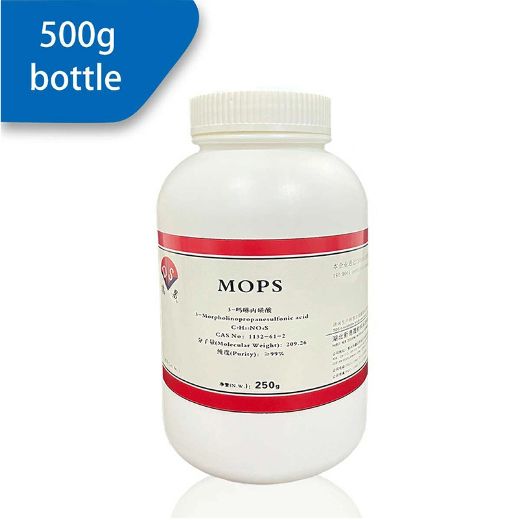
Product packaging
As a professional R&D and production manufacturer in the field of biological buffering agents, Desheng not only provides highly recognized MOPS buffering agents, but also covers dozens of widely used biological buffering agents such as TRIS, HEPES, CAPS, TAPS, BICINE, etc. in the market. We rely on excellent production technology to ensure that every product presents a pure white crystalline powder form, while also having excellent water solubility. Under strict production process control, we have achieved small batch differences and stable processes, providing stable and reliable support for your scientific research experiments. If you have any needs or questions about biological buffering agents, please feel free to contact us and we will be happy to serve you.
Contact details
Contact number
Address: C8, Guanggu United Science and Technology City, Ezhou City, Hubei Province
Fax:0711-3704 589
Follow us
