


What role does TAPS (Trimethylmethylaminopropane Sulfonic Acid) play in nanotechnology?
Release time:
2024-08-01
TAPS, Its chemical name is trihydroxymethylaminopropane sulfonic acid, and its molecular structure contains both basic amino groups and acidic sulfonic acid groups. This characteristic endows it with the ability to regulate a wide pH range and excellent water solubility. It is precisely this chemical structure that makes TAPS buffer shine in the field of nanodispersion. So, what role does TAPS (trihydroxymethylaminopropane sulfonic acid) play in nanotechnology?
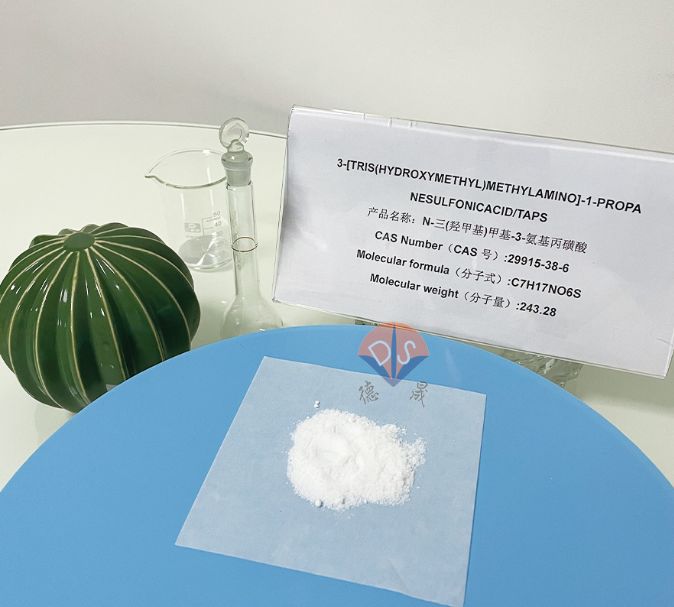
TAPS buffer
1. Prevent nanoparticle aggregation
The molecular structure of TAPS contains multiple hydroxyl and sulfonic acid groups, which can form stable hydrogen and ionic bonds with the surface of nanoparticles, thereby preventing their aggregation. Meanwhile, TAPS buffer solution also has good water solubility and stability, which can uniformly disperse nanoparticles in aqueous solution, providing strong guarantee for the preparation and application of nanomaterials.
2. pH adjustment ability
TAPS, as a biological buffering agent with high application frequency, can stabilize the pH value of the solution in a wide pH range (usually 6.5 to 8.5), which is crucial for maintaining the stability of the surface charge of nanoparticles. By adjusting pH, TAPS can optimize the charge distribution on the surface of nanoparticles, enhance electrostatic repulsion, and prevent particle aggregation.
3. Surface modification and stabilization
The amino and sulfonic acid groups in TAPS molecules can undergo physical adsorption or chemical reactions with the surface of nanoparticles, forming a stable protective layer. This protective layer not only improves the dispersion stability of nanoparticles, but also reduces direct contact between particles. This characteristic is particularly critical for nanomaterials such as metals, metal oxides, or quantum dots.
4. Improve the rheological properties of the dispersion
In high concentration nanoparticle dispersions, TAPS as a dispersant can significantly improve the rheological properties of the system, reduce viscosity, and make the dispersion easier to handle and process. This is particularly important for the preparation of nano coatings, inks, and even biomaterials, as it ensures the consistency and processability of the materials during application.
5. Expansion of application areas
TAPS, as a nano dispersant, has a wide range of applications, covering multiple cutting-edge fields such as nano delivery systems, biosensors, optoelectronic materials, and catalyst preparation. It can improve targeting efficiency, help nanoparticles form uniform thin films, enhance photoelectric conversion efficiency, optimize catalyst dispersion, enhance catalytic activity and stability.

Product packaging
In summary, TAPS (Trimethylmethylaminopropane Sulfonic Acid) plays the role of a dispersant in nanotechnology. TAPS, with its unique chemical charm, has solved many problems in nanodispersion and injected new vitality into the development of nanotechnology. In the future, with the continuous advancement of nanotechnology, the potential of TAPS as a dispersant will be further explored. As the R&D and production manufacturer of TAPS, Desheng will continue to conduct in-depth research on the dispersion mechanism and performance optimization of TAPS buffer solution, and explore more preparation methods and application fields of new nanomaterials.
Contact details
Contact number
Address: C8, Guanggu United Science and Technology City, Ezhou City, Hubei Province
Fax:0711-3704 589
Follow us
