


Acridine hydrazide NSP-SA-ADH biomolecular labeling tool
Release time:
2024-07-04
In the research of biochemistry and molecular biology, labeling technology has always played a crucial role. Labeling technology can achieve specific recognition, tracking, and detection of biomolecules, providing researchers with an important means to gain a deeper understanding of the functions, interactions, and biological processes of biomolecules. Among them, acridine hydrazide NSP-SA-ADH, as a novel labeling tool, has attracted much attention due to its chemical properties and wide application prospects.
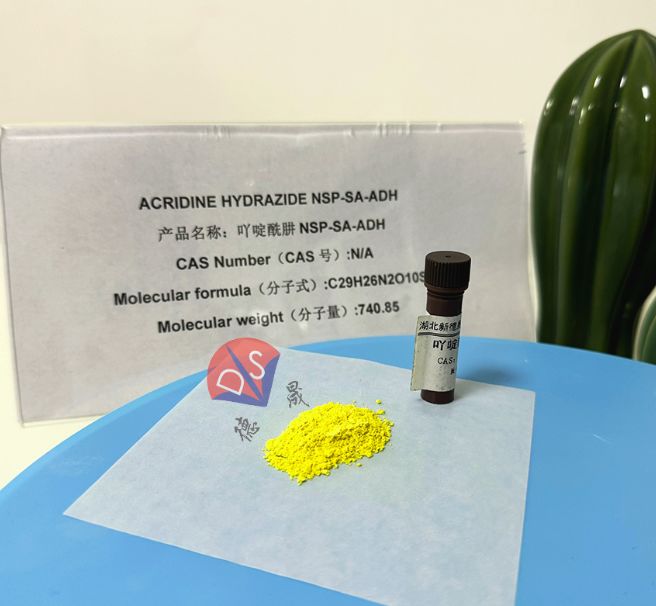
Acridyl hydrazide NSP-SA-ADH powder
Introduction to NSP-SA-ADH
Acridyl hydrazide NSP-SA-ADH is a compound based on the Acridyl hydrazide group, which has high stability and activity and can undergo specific reactions with various biomolecules. This compound usually exists in powder form, with a yellow appearance and a purity of over 98%. When storing, it needs to be placed in dry, dark, and low temperature conditions to maintain its stability and activity.
The labeling principle of acridine hydrazide NSP-SA-ADH
The labeling principle of acridine hydrazide NSP-SA-ADH is mainly based on the reaction between the active group at its end and biomolecules containing aldehyde groups. Aldehydes are a common active group widely present in the amino acid side chains of polysaccharides, nucleic acids, and proteins. When acridine hydrazide NSP-SA-ADH comes into contact with these biomolecules, the active group at its end undergoes a condensation reaction with the aldehyde group, forming a stable covalent bond. Through this reaction, acridine hydrazide NSP-SA-ADH can specifically label these biomolecules, giving them fluorescence properties.
Application fields of acridine hydrazide NSP-SA-ADH
1. Labeling of proteins, antigens, and antibodies
Labeling proteins, antigens, and antibodies is a common experimental method in immunology and proteomics research. NSP-SA-ADH can react with aldehyde groups in these biomolecules to achieve specific labeling. This labeling technique can not only be used to detect and analyze the expression levels of these biomolecules, but also to study their interactions, localization, and functions.
2. Labeling of nucleic acids (DNA, RNA)
Labeling DNA and RNA is crucial in molecular biology and genetic engineering research. NSP-SA-ADH can react with aldehyde groups in nucleic acids to achieve specific labeling of DNA and RNA. This labeling technique can be used to detect and analyze gene expression levels, mutations, and interactions between genes.
3. Labeling of polysaccharides
Polysaccharides are an important class of biomolecules that play important roles in the construction of cell walls, membranes, and interstitium. NSP-SA-ADH can react with aldehyde groups in polysaccharides to achieve specific labeling of polysaccharides. This labeling technique can be used to study the structure, function, and interaction with other biomolecules of polysaccharides.
The advantages of acridine hydrazide NSP-SA-ADH
1. High specificity: Acridyl hydrazide NSP-SA-ADH can react specifically with biomolecules containing aldehyde groups, achieving accurate labeling of target molecules.
2. High stability: This compound has high stability and can maintain its activity and fluorescence characteristics under conventional experimental conditions.
3. High sensitivity: By labeling with acridine hydrazide NSP-SA-ADH, high sensitivity detection and analysis of target molecules can be achieved.
4. Multifunctionality: This compound can be applied to different types of biomarkers, including proteins, antigens, antibodies, nucleic acids, and polysaccharides.
Conclusion
NSP-SA-ADH, as a novel biomarker tool, has shown broad application prospects in the research of biochemistry and molecular biology. Through its labeling principles and advantages, researchers can gain a deeper understanding of the functions, interactions, and biological processes of biomolecules, making important contributions to the development of biomedical and life sciences.
 Product packaging
The acridine hydrazide NSP-SA-ADH reagent has shown great practicality in the fields of biochemistry and molecular biology. It not only plays a crucial role in protein labeling and detection, but also serves as a powerful assistant in specific enzyme catalyzed reactions. Given its significant application value and advantages, it is particularly important to choose a supplier with stable supply when conducting experiments.
Desheng has close cooperation with many universities. Its R&D team is led by experts, which ensures the reliability of product quality and the progressiveness of technology. Under strict quality control, Desheng's acridine hydrazide NSP-SA-ADH and other chemiluminescent reagents emit stable light with high efficiency, providing strong support for your experiments. If you are interested in this product or have any questions, please feel free to contact us at any time. We look forward to providing you with professional consultation and services.
Contact details
Contact number
Address: C8, Guanggu United Science and Technology City, Ezhou City, Hubei Province
Fax:0711-3704 589
Follow us
