


Who has a slight advantage in the competition between Luminol and Isoluminol?
Release time:
2024-07-01
Luminol and Isoluminol have their own strengths in the field of chemistry. Luminol's occult blood reaction and stability play an important role in criminal investigation, and its luminescent properties provide strong technical support for forensic science. Although each has its own emphasis on usage, they are undoubtedly outstanding representatives in the field of chemistry. So who is slightly better.
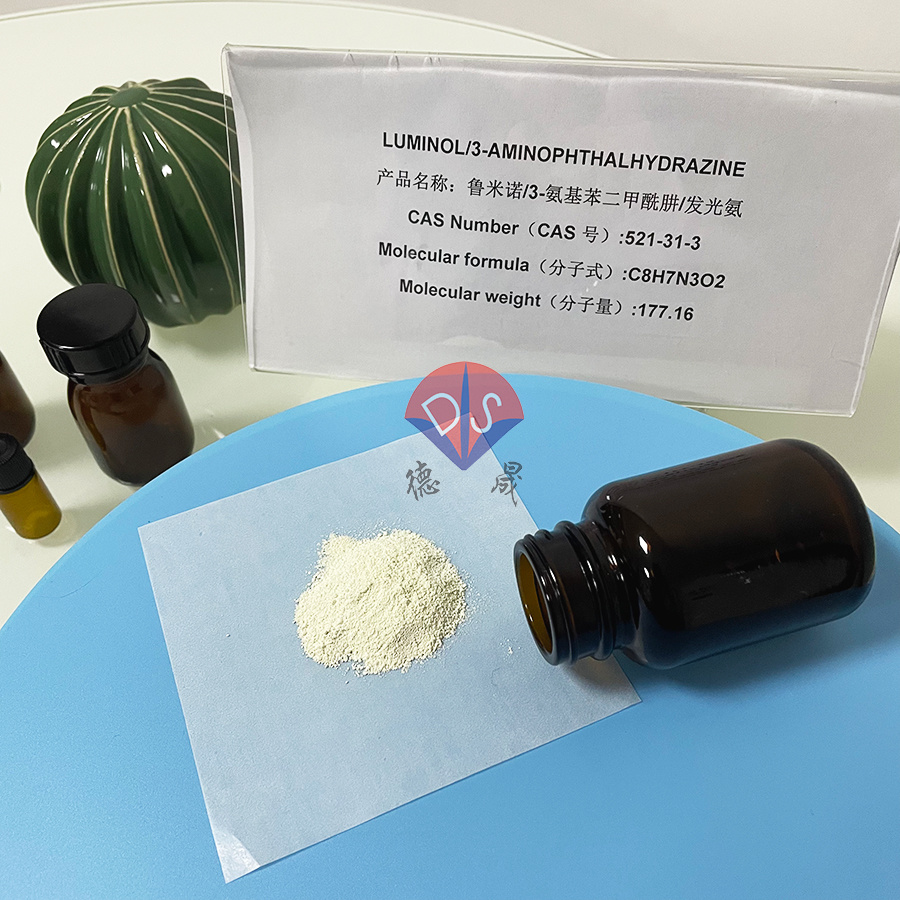
luminol powder
Analysis of the advantages and disadvantages of Luminol
advantage:
High sensitivity: Luminol can detect extremely small amounts of blood, making it suitable for visualizing trace amounts of blood in crime scene investigations.
Easy to operate: The preparation and use of luminol solution are relatively simple, making it convenient for rapid on-site detection.
Intuitive effect: The blue-green fluorescence generated by the luminescent reaction is visible to the naked eye and does not require special equipment for observation.
Broad spectrum application: In addition to blood testing, luminol can also be used to detect other substances containing iron or copper, as well as to determine the activity of certain enzymes.
Disadvantages:
There are multiple interfering factors: other substances containing iron or oxidants may also trigger luminol luminescence, leading to false positive results.
Short duration: The luminescence effect of Luminol has a short duration, which limits the time window for observation and recording.
Analysis of the advantages and disadvantages of Isoluminol
advantage:
Strong specificity: Through molecular design, some isomer derivatives can have higher selectivity and sensitivity towards specific target molecules, reducing false positives.
Spectral tunability: Through chemical modification, derivatives with different luminescent colors can be obtained, facilitating the application of multiple labeling or detection channels.
Disadvantages:
Complex synthesis: Compared to luminol, the synthesis of specific isomers of luminol may be more complex and costly.
Limited application scope: Due to its enhanced specificity, it may not be suitable for a wide range of detection types and may not be as versatile as Luminol.

Product packaging
Do Luminol and Isoluminol require the addition of catalysts for luminescence?
Luminol luminescence typically requires the addition of catalysts, such as multivalent metal ions or peroxidases, to accelerate its redox reaction with peroxides, thereby emitting light. Isoluminol, on the other hand, can react directly with various oxidants to emit light without a catalyst, exhibiting good water solubility and high luminescence quantum yield, as well as sensitivity and strong anti-interference ability. So, luminol luminescence typically requires a catalyst, while isoluminol does not.
Luminol produced by Desheng is widely used in practical applications, especially in forensic science, due to its high sensitivity and easy operation. Isoluminol derivatives, on the other hand, have shown potential in specific fields such as applications that require higher specificity and luminescence efficiency, but may face challenges in terms of cost and application maturity. Overall, both Lumino and Isolumino play irreplaceable roles in specific fields.
Contact details
Contact number
Address: C8, Guanggu United Science and Technology City, Ezhou City, Hubei Province
Fax:0711-3704 589
Follow us
