


Will protein activity be affected after labeling with acridine ester?
Release time:
2024-05-18
In biochemical research, labeling technology is a commonly used means for tracking, detecting, and quantifying biomolecules. Among them, acridine ester, as a chemiluminescent marker, is widely used in protein labeling experiments. However, a common question when using acridine ester for protein labeling is: Will the labeling process affect protein activity? This article will explore this issue from multiple perspectives.
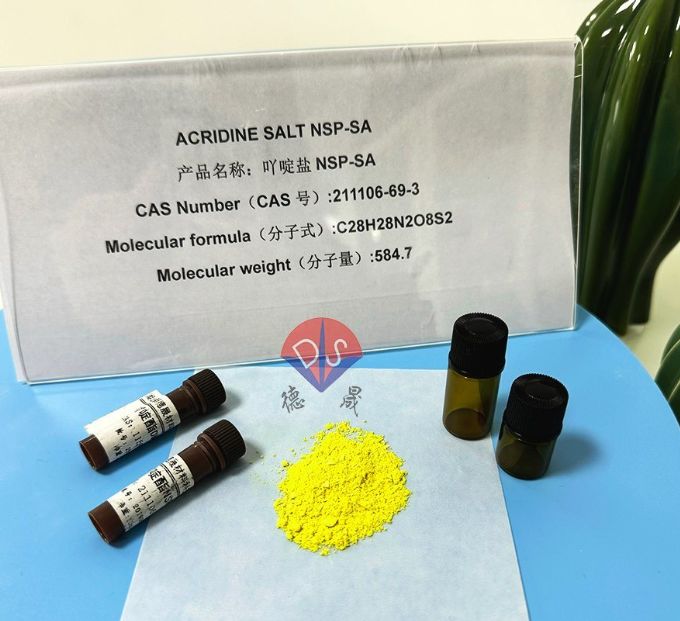
Acridine ester powder
The principle and application of acridine ester labeling
Acridine ester is a luminescent group that can bind to amino groups in proteins through specific chemical reactions, thereby achieving protein labeling. This labeling method has the advantages of high sensitivity and good specificity, and has been widely used in protein analysis, immune detection, and other fields. By labeling, we can easily track the distribution, dynamic changes, and interactions with other molecules of proteins within the organism.
The influence of labeling process on protein activity
Although acridine ester labeling provides a powerful tool for protein research, the labeling process itself may also have an impact on protein activity. This impact may come from multiple aspects:
Labeling reactions typically require time and conditions such as temperature, pH value, etc. If the reaction conditions are not properly controlled, it may lead to changes in the structure of the protein, thereby affecting its activity. For example, excessively high temperatures may cause protein denaturation, while excessively low pH values may disrupt the active centers of proteins.
Secondly, labeling reactions may introduce new chemical groups or alter the charge distribution of proteins, thereby affecting their interactions with other molecules. This change in interaction may lead to changes in the localization, function, or stability of proteins within the cell.
In addition, the labeled protein may be affected by environmental factors such as solvent and ion strength, leading to changes in its activity. For example, certain solvents may disrupt the stable structure of proteins, and changes in ion strength may affect the binding ability of proteins to ligands.
Factors affecting protein activity and corresponding measures
To reduce the impact of acridine ester labeling on protein activity, we can take the following measures:
1. Optimize labeling reaction conditions: By selecting appropriate solvents, pH values, temperatures, and times, the structure and function of proteins can be maximally preserved. In addition, using mild reaction conditions can also help reduce side effects.
2. Choose appropriate proteins for labeling: Different proteins have different sensitivities to the labeling process, so it is necessary to select suitable proteins based on specific research objectives. For example, for proteins with stable structures and clear functions, the likelihood of their labeled activity being affected is relatively low.
3. Strict activity testing of labeled proteins: By comparing the changes in protein activity before and after labeling, the degree of impact of the labeling process on protein activity can be evaluated. If the loss of activity is significant, you can try adjusting the labeling conditions or choosing other labeling methods.

Product packaging
Conclusion
The impact of acridine ester labeling on protein activity is a complex and important issue. Although the labeling process may alter the structure and function of proteins to some extent, we can reduce this impact by optimizing labeling conditions and selecting appropriate proteins. In the future, with the continuous development and improvement of labeling technology, we are expected to more accurately control the labeling process, thereby reducing the impact on protein activity. Meanwhile, for the study of specific proteins, milder labeling methods or alternative techniques can also be explored to meet different research needs.
In summary, when using acridine esters for protein labeling, we need to fully consider the impact of the labeling process on protein activity and take corresponding measures to reduce this impact. Through scientific design and rigorous experimental verification, we can use labeling techniques to reveal the function and regulatory mechanisms of proteins.
Contact details
Contact number
Address: C8, Guanggu United Science and Technology City, Ezhou City, Hubei Province
Fax:0711-3704 589
Follow us
