


How MOPS buffer makes proteins more stable
Release time:
2024-05-14
MOPS buffer mainly interacts with the peptide backbone of bovine serum protein to make the protein more stable. This interaction can lead to the net stability of proteins, which helps to maintain the structure and function of proteins in biochemical experiments and research processes, thereby improving the accuracy and reliability of experiments. So, how does MOPS buffer interact with proteins.

MOPS buffer powder
MOPS buffer and protein interaction
1.The interaction between MOPS buffer and proteins is mainly reflected in its ability to stabilize the structure and function of proteins. This stability mainly comes from the complex formed by the sulfonic acid groups in the MOPS buffer and metal ions (such as Mg2+and Ca2+), which are crucial for maintaining the structure and function of proteins. In addition, sulfonic acid groups can also form ion pairs with positively charged residues on the protein surface, further stabilizing the structure of the protein.
2.In biochemical experiments, the activity of many enzymes and proteins is closely related to pH values, and changing pH values can affect their function and stability. The main function of MOPS buffer is to maintain the acid-base balance of the solution and prevent drastic changes in pH value. It can maintain the pH value of the solution under acidic and alkaline conditions, providing a relatively stable reaction environment for proteins.
3. In the process of protein electrophoresis separation, MOPS buffer can also adjust the hardness and ionic strength of gel to optimize the effect of electrophoresis separation. At the same time, it can also adjust the mesh size of gel, affect the migration speed of proteins, so as to achieve the separation of proteins with different molecular weights.
How MOPS buffer makes proteins more stable
1. pH stability: MOPS buffer has a moderate pH range, which makes it very suitable for the expression and folding conditions of many proteins. Within this pH range, MOPS can provide a stable environment for protein folding in cells, which is crucial for obtaining functionally complete proteins within the cell.
2. Good chemical stability: MOPS buffer is not easily decomposed during long-term storage and use, which can ensure the stability and repeatability of experimental results. This stability ensures that the protein can maintain its structure and function over a long period of experimental time.
3. Lower cytotoxicity: MOPS buffer has a smaller impact on cell growth and protein expression, which means that in experiments such as cell culture and protein extraction, MOPS buffer can provide a relatively mild environment for proteins, reducing interference with their structure and function.
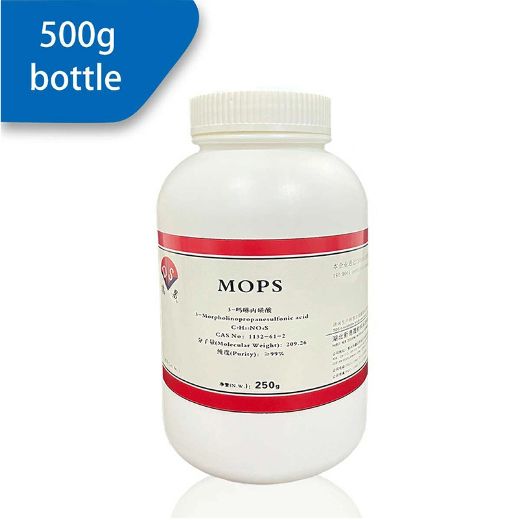
Product packaging
Overall, the interaction between MOPS buffer and proteins is complex, but mainly based on its maintenance of pH stability, good chemical stability, low cytotoxicity, and direct interaction with proteins to make proteins more stable. These characteristics make MOPS buffer widely applicable in biochemical experiments and research, especially in experiments involving proteins.
Contact details
Contact number
Address: C8, Guanggu United Science and Technology City, Ezhou City, Hubei Province
Fax:0711-3704 589
Follow us
