


The role of luminol in in in vitro diagnostic reagents
Release time:
2024-03-13
Luminol, this magical chemiluminescent reagent, has a wide range of applications in the biomedical field, especially in vitro diagnostic reagents, where it plays a crucial role. Luminol reagent, with its luminescent properties, provides researchers and clinical doctors with powerful detection tools, enabling them to more accurately understand physiological and pathological changes in organisms. This article will explore in detail the important role of luminol in in in vitro diagnostic reagents.
Luminol's Luminescence Principle
Luminol is an organic compound, and its luminescence principle is based on chemiluminescence reactions. When luminol reacts with appropriate oxidants (such as hydrogen peroxide) under alkaline conditions, an excited intermediate is generated. This intermediate releases photons during its return to the ground state, resulting in visible light. This luminescent phenomenon not only has high sensitivity, but also has good anti-interference ability, so it is widely used in biomedical detection.

Luminol powder
The application of luminol in in vitro diagnostic reagents
1. Immunodiagnosis
Immunodiagnosis is a method of detecting specific substances in biological samples using specific reactions between antigens and antibodies. Luminol, as a chemiluminescent reagent, can bind to antigens or antibodies to form markers. When the marker undergoes a specific reaction with the corresponding substance in the sample to be tested, luminol will emit a light signal. By measuring the intensity of the light signal, the concentration or presence of the substance to be tested can be quantitatively or qualitatively determined. This method has the advantages of high sensitivity, high specificity, and good repeatability, and has been widely used in clinical diagnosis and scientific research.
2. Bioluminescence imaging
The luminescent properties of Lumino can also be used for bioluminescence imaging. By combining luminol with specific biomolecules, visual observation of specific processes within the organism can be achieved. For example, in inflammation research, luminol can bind to myeloperoxidase and emit bright blue fluorescence. By observing the distribution and intensity of fluorescence signals, the occurrence, development, and resolution of inflammation can be intuitively understood. This method is of great significance for studying the pathogenesis and treatment strategies of inflammatory related diseases (such as atherosclerosis, neurodegenerative diseases, etc.).
3. Enzyme activity detection
Luminol can also be used to detect enzyme activity in biological samples. Some enzymes can catalyze the luminescence reaction between luminol and hydrogen peroxide, thereby enhancing the intensity of the light signal. By measuring changes in luminescence intensity, the activity level of enzymes can be indirectly reflected. This method has been widely applied in fields such as in vitro diagnosis of enzyme activity and drug screening.
The advantages and limitations of Luminol
Luminol, as a chemiluminescent reagent in in vitro diagnostics, has many advantages. Firstly, it has high sensitivity and specificity, and can accurately detect trace substances in biological samples. Secondly, the luminescence reaction of luminol is fast and stable, making it suitable for high-throughput automated detection. In addition, Lumino also has good storage stability, making it convenient for transportation and use.
However, Lumino also has some limitations. Firstly, it is sensitive to environmental conditions such as acidity, alkalinity, and temperature, and requires reaction under suitable conditions. Secondly, luminol may undergo non-specific reactions with other substances, leading to false positive or false negative results. Therefore, when using luminol for in vitro diagnosis, it is necessary to strictly control the experimental conditions and select appropriate control substances for validation.
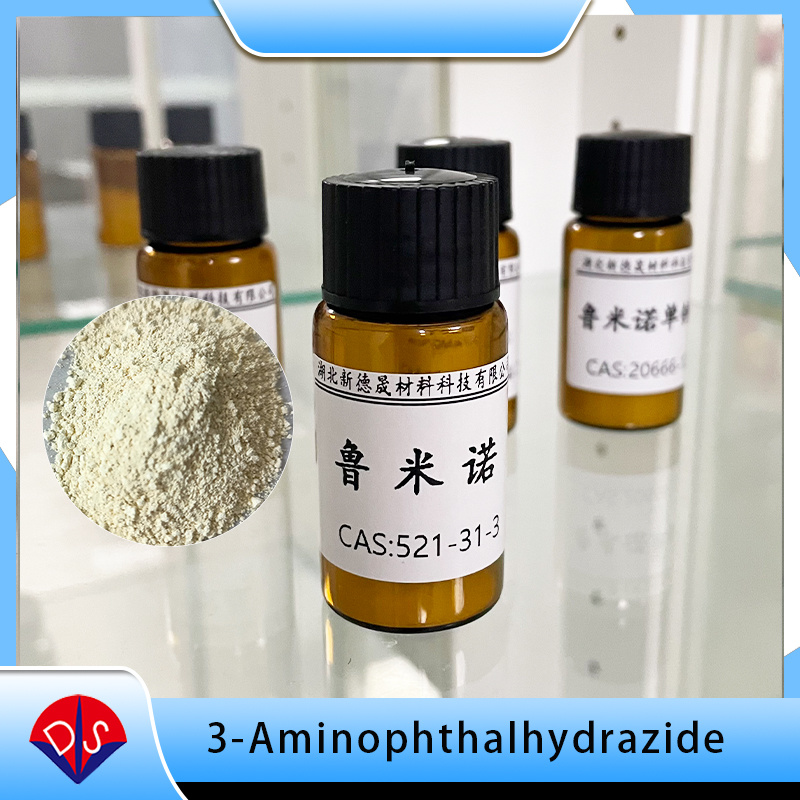
Product packaging
Conclusion
In summary, luminol plays an important role in in in vitro diagnostic reagents. It provides powerful detection tools for researchers and clinical doctors through its luminescent properties, enabling them to gain a deeper understanding of physiological and pathological changes within the organism. With the continuous development of science and technology, it is believed that the application of luminol in the field of in vitro diagnosis will be more extensive and in-depth.
Hubei Xindesheng Material Technology Co., Ltd. is a well-known manufacturer in China that researches and produces chemiluminescent reagents. The research on Luminol has a history of nearly 20 years, with stable production processes to ensure product quality, advanced production equipment to ensure shipment volume, and a professional R&D team and sales team to ensure after-sales service. Therefore, Lumino produced by Desheng has received unanimous praise from domestic and foreign customers. If you have any relevant needs, you can click on the official website to learn more or contact me!
Contact details
Contact number
Address: C8, Guanggu United Science and Technology City, Ezhou City, Hubei Province
Fax:0711-3704 589
Follow us
